


 Cart
Cart
 sales@molnova.com


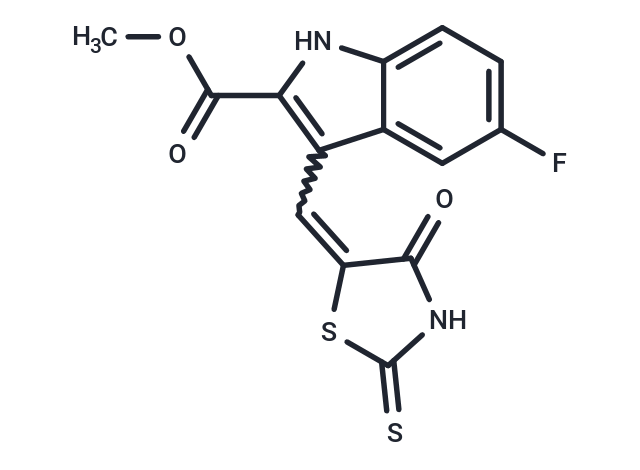
Anticancer agent 43
CAS No. 2470015-35-9
Anticancer agent 43( —— )
Catalog No. M35504 CAS No. 2470015-35-9
Anticancer agent 43 is a potent anticancer agent that induces apoptosis through caspase 3, PARP1, and Bax protein-dependent pathways.
Purity : >98% (HPLC)
 COA
Datasheet
HNMR
HPLC
MSDS
Handing Instructions
COA
Datasheet
HNMR
HPLC
MSDS
Handing Instructions
| Size | Price / USD | Stock | Quantity |
| 5MG | 80 | In Stock |


|
| 10MG | 132 | In Stock |
|
| 25MG | 221 | In Stock |
|
| 50MG | 323 | In Stock |
|
| 100MG | 480 | In Stock |
|
| 200MG | Get Quote | In Stock |
|
| 500MG | 1014 | In Stock |
|
| 1G | Get Quote | In Stock |
|
Biological Information
-
Product NameAnticancer agent 43
-
NoteResearch use only, not for human use.
-
Brief DescriptionAnticancer agent 43 is a potent anticancer agent that induces apoptosis through caspase 3, PARP1, and Bax protein-dependent pathways.
-
DescriptionAnticancer Agent 43 is a potent anticancer agent. Anticancer Agent 43 induces apoptosis by caspase 3, PARP1, and Bax dependent mechanisms. Anticancer Agent 43 induces DNA damage.
-
In VitroAnticancer agent 43 (compound 3a) shows selectivity toward human tumor cells (SI50=28.94).Anticancer agent 43 (45 μM, 24 h) induces apoptosis via caspase 3, PARP1 and Bax dependent pathways in HepG2 cells.Anticancer agent 43 (45 μM, 24 h) shows no effect on the transition of G1/S phases in HepG2 cells.Anticancer agent 43 (0.7, 45, 55 μM) induces DNA damage in HCT116 cells (Tail DNA=16.1%, OTM=3.7), MCF-7 cells, HepG2 cells (Tail DNA=26.2%, OTM=13.2), Balb/c 3T3 cells (Tail DNA = 8.4%, OTM = 3.5)..Cell Cytotoxicity Assay Cell Line:HepG2, MCF-7, HCT116, HeLa, A549, WM793, THP-1, HaCaT, Balb/c3T3 cells Concentration:0, 1, 10, 100 μM Incubation Time:72 h Result:Showed cytotoxic action with GI50s of 12.1, 0.7, 0.8, 49.3, 9.7 μM for for HepG2, MCF-7, HCT116, HeLa, A549 cells, low toxicity towards WM793, THP-1, HaCaT, Balb/c 3T3 cells with GI50s of 80.4, 62.4,98.3,40.8 μM , respectively.Apoptosis Analysis Cell Line:HepG2 cells Concentration:45 μM Incubation Time:24 h Result:Induced apoptosis in HepG2 cells via caspase 3, PARP1 and Bax dependent pathways.Western Blot Analysis Cell Line:HCT116, MCF-7 cells Concentration:0.7 μM Incubation Time:24 h Result:Decreased the expression of Cdk2 protein in HCT116 and MCF-7 cells.Cell Cycle Analysis Cell Line:HepG2 cells Concentration:45 μM Incubation Time:24 h Result:Showed no effect on the transition of G1/S phases in HepG2 cells.
-
In Vivo——
-
Synonyms——
-
PathwayApoptosis
-
TargetApoptosis
-
RecptorApoptosis
-
Research Area——
-
Indication——
Chemical Information
-
CAS Number2470015-35-9
-
Formula Weight336.36
-
Molecular FormulaC14H9FN2O3S2
-
Purity>98% (HPLC)
-
SolubilityIn Vitro:?DMSO : 125 mg/mL (371.63 mM; Ultrasonic )
-
SMILESC(C=1C=2C(NC1C(OC)=O)=CC=C(F)C2)=C3C(=O)NC(=S)S3
-
Chemical Name——
Shipping & Storage Information
-
Storage(-20℃)
-
ShippingWith Ice Pack
-
Stability≥ 2 years
Reference
1. Kryshchyshyn-Dylevych A, et al. Synthesis of novel indole-thiazolidinone hybrid structures as promising scaffold with anticancer potential. Bioorg Med Chem. 2021; 50:116453.?
molnova catalog



related products
-
Fluorizoline
Fluorizoline is a PHB-binding compound with anticancer and antiproliferative activity that induces apoptosis by inducing selective targeting of the BH3 protein NOXA to PHB.Fluorizoline inhibits protein synthesis and has been used in studies of leukemia.
-
CMLD-2
CMLD-2 is an inhibitor of HuR-ARE interaction (Ki: 350 nM) that competitively binds HuR protein and disrupts its interaction with adenine element-rich (ARE) mRNA targets.
-
Ponicidin
Ponicidin is a diterpenoid derived from Rabdosia rubescens. Ponicidin exhibits immunoregulatory, anti-inflammatory, anti-viral, and anti-cancer activity.
