


 Cart
Cart
 sales@molnova.com


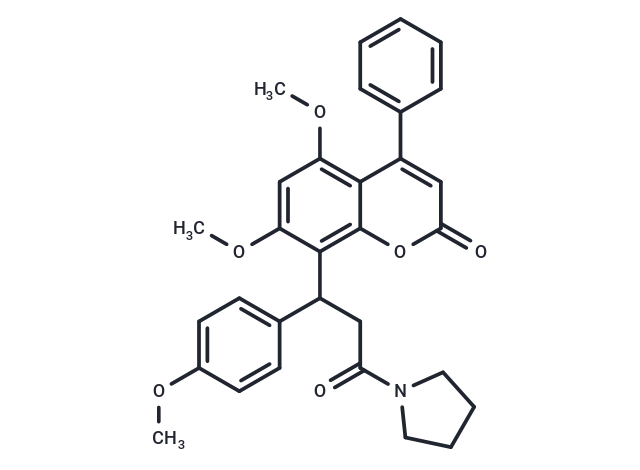
CMLD-2
CAS No. 958843-91-9
CMLD-2( —— )
Catalog No. M34849 CAS No. 958843-91-9
CMLD-2 is an inhibitor of HuR-ARE interaction (Ki: 350 nM) that competitively binds HuR protein and disrupts its interaction with adenine element-rich (ARE) mRNA targets.
Purity : >98% (HPLC)
 COA
Datasheet
HNMR
HPLC
MSDS
Handing Instructions
COA
Datasheet
HNMR
HPLC
MSDS
Handing Instructions
| Size | Price / USD | Stock | Quantity |
| 1 mL x 10 mM in DMSO | 258 | In Stock |


|
| 5MG | 235 | In Stock |
|
| 10MG | 392 | In Stock |
|
| 25MG | 642 | In Stock |
|
| 50MG | 877 | In Stock |
|
| 100MG | 1181 | In Stock |
|
| 200MG | Get Quote | In Stock |
|
| 500MG | 2353 | In Stock |
|
| 1G | Get Quote | In Stock |
|
Biological Information
-
Product NameCMLD-2
-
NoteResearch use only, not for human use.
-
Brief DescriptionCMLD-2 is an inhibitor of HuR-ARE interaction (Ki: 350 nM) that competitively binds HuR protein and disrupts its interaction with adenine element-rich (ARE) mRNA targets.
-
DescriptionCMLD-2, an inhibitor of HuR-ARE interaction, competitively binds HuR protein disrupting its interaction with adenine-uridine rich elements (ARE)-containing mRNAs (Ki=350 nM). CMLD-2 induces apoptosis exhibits antitumor activity in different cancer cells as colon, pancreatic, thyroid and lung cancer cell lines. Hu antigen R (HuR) is an RNA binding protein, can regulate target mRNAs stability and translation.
-
In VitroCell Viability Assay Cell Line:SW1736, 8505C, BCPAP and K1 cells Concentration:1, 5, 10, 25, 35, 50, 75 μM Incubation Time:24, 48, 72 hours Result:Reduced the viability of all the four cell lines when used at 35, 50 and 75?μM concentration and at different time points.Apoptosis AnalysisCell Line:H1299, A549, H1975, HCC827, MRC-9 and CCD16 cells Concentration:20, 30 μM Incubation Time:24, 48 hours Result:Marked activated the caspase-9 and -3 in lung tumor cells.Induce the cleavage of PARP in lung tumor cells.Significantly increased the annexin-V-positive staining in lung tumor cells.Cell Cycle Analysis Cell Line:H1299, A549, MRC-9 and CCD16 cells Concentration:30 μM Incubation Time:24, 48 hours Result:Induced greater G1 phase cell cycle arrest in H1299 and A549 cells than in MRC-9 and CCD16 cells.Western Blot Analysis Cell Line:H1299, A549, H1975, HCC827, CCD16 and MRC-9 cells Concentration:20, 30 μM Incubation Time:24, 48 hours Result:Diminished protein expression of HuR, Bcl-2, Cyclin E and Bcl-XL and increased expression of p27 and BAX in lung tumor cells.
-
In Vivo——
-
Synonyms——
-
PathwayApoptosis
-
TargetApoptosis
-
RecptorApoptosis | HuR
-
Research Area——
-
Indication——
Chemical Information
-
CAS Number958843-91-9
-
Formula Weight513.58
-
Molecular FormulaC31H31NO6
-
Purity>98% (HPLC)
-
SolubilityIn Vitro:?DMSO : 50 mg/mL (97.36 mM; Ultrasonic )
-
SMILESCOc1ccc(cc1)C(CC(=O)N1CCCC1)c1c(OC)cc(OC)c2c(cc(=O)oc12)-c1ccccc1
-
Chemical Name——
Shipping & Storage Information
-
Storage(-20℃)
-
ShippingWith Ice Pack
-
Stability≥ 2 years
Reference
1. Wu X, et, al. Identification and validation of novel small molecule disruptors of HuR-mRNA interaction. ACS Chem Biol. 2015 Jun 19;10(6):1476-84.?
molnova catalog



related products
-
Polyporenic acid C
Polyporenic acid C shows inhibitory activity against human collagenase.
-
(+)-Nortrachelogenin
(+)-Nortrachelogenin is a lignan isolated from Wikstroemia indica C.A. Meyer (Thymelaeaceae). (+)-Nortrachelogenin possesses antileukemic activity.
-
(S)-Thalidomide
(S)-Thalidomide ((S)-(-)-Thalidomide) is the S-isomer of Thalidomide with immunomodulatory, anti-inflammatory, anticancer, anti-angiogenic, and pro-apoptotic activities, used in studying leprosy erythema nodosum and myeloma.
