


 Cart
Cart
 sales@molnova.com


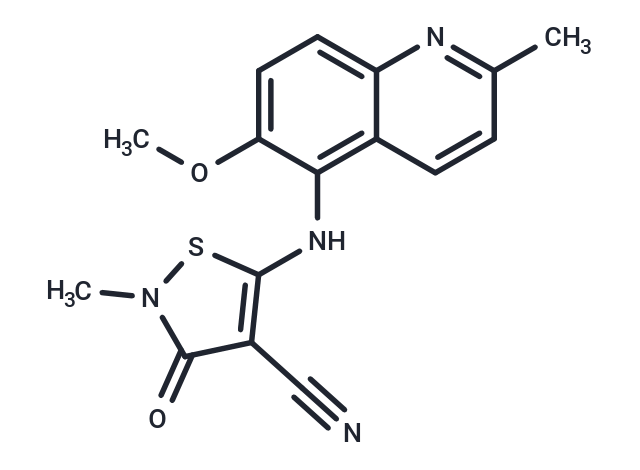
SARM1-IN-2
CAS No. 2396592-52-0
SARM1-IN-2( —— )
Catalog No. M35488 CAS No. 2396592-52-0
SARM1-IN-2 is a potent SARM1 inhibitor for the study of metabolic and neurological related diseases.
Purity : >98% (HPLC)
 COA
Datasheet
HNMR
HPLC
MSDS
Handing Instructions
COA
Datasheet
HNMR
HPLC
MSDS
Handing Instructions
| Size | Price / USD | Stock | Quantity |
| 2MG | 283 | In Stock |


|
| 100MG | Get Quote | In Stock |
|
| 200MG | Get Quote | In Stock |
|
| 500MG | Get Quote | In Stock |
|
| 1G | Get Quote | In Stock |
|
Biological Information
-
Product NameSARM1-IN-2
-
NoteResearch use only, not for human use.
-
Brief DescriptionSARM1-IN-2 is a potent SARM1 inhibitor for the study of metabolic and neurological related diseases.
-
DescriptionSARM1-IN-2 is a SARM1 inhibitor extracted from patent WO2019236890A1 example 82. SARM1-IN-2 can be used for the research of axonal degeneration.
-
In Vitro——
-
In Vivo——
-
Synonyms——
-
PathwayOthers
-
TargetOther Targets
-
RecptorOthers
-
Research Area——
-
Indication——
Chemical Information
-
CAS Number2396592-52-0
-
Formula Weight326.37
-
Molecular FormulaC16H14N4O2S
-
Purity>98% (HPLC)
-
SolubilityIn Vitro:?DMSO : 10 mg/mL (30.64 mM; Ultrasonic )
-
SMILESN#CC=1C(=O)N(SC1NC=2C(OC)=CC=C3N=C(C=CC32)C)C
-
Chemical Name——
Shipping & Storage Information
-
Storage(-20℃)
-
ShippingWith Ice Pack
-
Stability≥ 2 years
Reference
1. Hughes RO, et, al. Inhibitors of sarm1. WO2019236890A1.
molnova catalog



related products
-
Adrenomedullin (16-3...
Adrenomedullin (16-31), human is amino acid residues 16-31 fragment of human adrenomedullin (hADM).
-
dicoumarol
dicoumarol
-
rac-NBI-74330
rac-NBI-74330 is an effective and selective CXCR3 antagonist.
