


 Cart
Cart
 sales@molnova.com


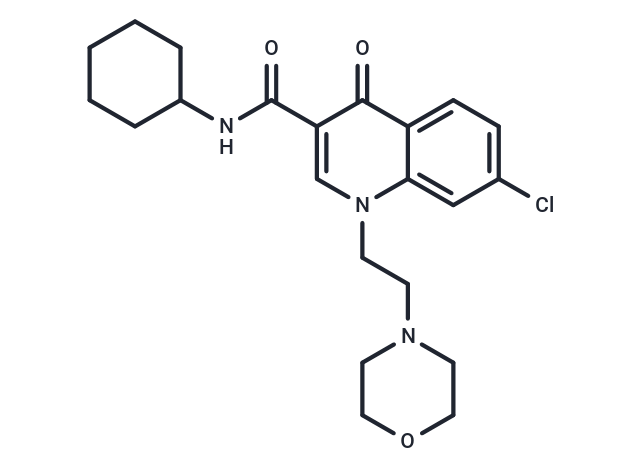
CB 65
CAS No. 913534-05-1
CB 65( —— )
Catalog No. M35264 CAS No. 913534-05-1
CB 65 is a high affinity and selective CB2 receptor agonist with Ki values of 3.3 and > 1000 nM for CB2 and CB1 receptors respectively.
Purity : >98% (HPLC)
 COA
Datasheet
HNMR
HPLC
MSDS
Handing Instructions
COA
Datasheet
HNMR
HPLC
MSDS
Handing Instructions
| Size | Price / USD | Stock | Quantity |
| 5MG | 79 | In Stock |


|
| 10MG | 119 | In Stock |
|
| 25MG | 201 | In Stock |
|
| 50MG | 293 | In Stock |
|
| 100MG | 417 | In Stock |
|
| 200MG | 589 | In Stock |
|
| 500MG | Get Quote | In Stock |
|
| 1G | Get Quote | In Stock |
|
Biological Information
-
Product NameCB 65
-
NoteResearch use only, not for human use.
-
Brief DescriptionCB 65 is a high affinity and selective CB2 receptor agonist with Ki values of 3.3 and > 1000 nM for CB2 and CB1 receptors respectively.
-
DescriptionCB65 is a potent and high affinity CB2 selective agonist with a Ki value of 3.3 nM. CB65 exhibits a Ki of >1000 nM for CB1 receptor.
-
In Vitro——
-
In Vivo——
-
Synonyms——
-
PathwayGPCR/G Protein
-
TargetCannabinoid Receptor
-
RecptorCannabinoid Receptor
-
Research Area——
-
Indication——
Chemical Information
-
CAS Number913534-05-1
-
Formula Weight417.93
-
Molecular FormulaC22H28ClN3O3
-
Purity>98% (HPLC)
-
SolubilityIn Vitro:?DMSO : 5 mg/mL (11.96 mM; Ultrasonic (<60°C)
-
SMILESC(CN1CCOCC1)N2C=3C(C(=O)C(C(NC4CCCCC4)=O)=C2)=CC=C(Cl)C3
-
Chemical Name——
Shipping & Storage Information
-
Storage(-20℃)
-
ShippingWith Ice Pack
-
Stability≥ 2 years
Reference
1. CB 65 is a high affinity and selective CB2 receptor agonist; Ki?values are 3.3 and > 1000 nM for CB2 and CB1 receptors respectively. ?
molnova catalog



related products
-
Alismoxide
Alismoxide has anti-inflammatory effects.
-
WIN 55,212-2 mesylat...
WIN 55,212-2 mesylate (WIN 55212-2) is a potent cannabinoid receptor agonist with Ki of 62.3 and 3.3 nM for human recombinant CB1 and CB2 receptors, respectively.
-
MJ 15
MJ 15 is a CB1 receptor antagonist with specificity for the study of obesity-induced diseases.
