


 Cart
Cart
 sales@molnova.com


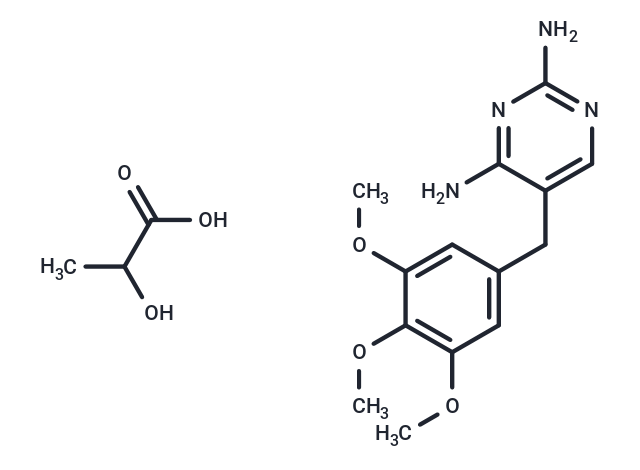
Trimethoprim lactate
CAS No. 23256-42-0
Trimethoprim lactate( —— )
Catalog No. M35165 CAS No. 23256-42-0
Trimethoprim lactic is a bacteriostatic antibiotic and an orally active dihydrofolate reductase inhibitor. Trimethoprim lactic is active against a wide range of Gram-positive and Gram-negative aerobic bacteria .
Purity : >98% (HPLC)
 COA
Datasheet
HNMR
HPLC
MSDS
Handing Instructions
COA
Datasheet
HNMR
HPLC
MSDS
Handing Instructions
| Size | Price / USD | Stock | Quantity |
| 1 mL x 10 mM in DMSO | 44 | In Stock |


|
| 100MG | Get Quote | In Stock |
|
| 200MG | 28 | In Stock |
|
| 500MG | 39 | In Stock |
|
| 1G | Get Quote | In Stock |
|
Biological Information
-
Product NameTrimethoprim lactate
-
NoteResearch use only, not for human use.
-
Brief DescriptionTrimethoprim lactic is a bacteriostatic antibiotic and an orally active dihydrofolate reductase inhibitor. Trimethoprim lactic is active against a wide range of Gram-positive and Gram-negative aerobic bacteria .
-
DescriptionTrimethoprim lactate is a bacteriostatic antibiotic and an orally active dihydrofolate reductase inhibitor. Trimethoprim lactate is active against a wide range of Gram-positive and Gram-negative aerobic bacteria. Trimethoprim lactate has the potential for the research of urinary tract infections, Shigellosis and Pneumocystis pneumonia. Trimethoprim lactate can inhibit infection of Influenza A virus in chick embryo when combinated with zinc.
-
In VitroTrimethoprim interrupts folate metabolism by inhibition of the activity of dihydrofolase reductase (DHFR), which reduces dihydrofolate to tetrahydrofolate (THF).Trimethoprim (3 μg/mL; 1 h) induces protein aggregation and main heat shock proteins (Hsps) in E. coli cells, which indicates that Trimethoprim sulfate presence leads to protein misfolding.Trimethoprim (1.5-3 μg/mL; 1 h) causes induction of DnaK, DnaJ, GroEL, ClpB, and IbpA/B Hsps in E. coli cells exposed to folate and heat stress.
-
In VivoTrimethoprim (10 mg/kg; i.v.; once every 12 h; 3 d) shows antibacterial activity against H. influenzae, S. pneumoniae, E. coli and N. meningitidis in infected mice.Trimethoprim can be connected with the thiomaltose (TM-TMP) and shows stability with a half-life of about 1 hour in complete serum, and has an MIC value around 1 μM against E. coli.Trimethoprim (10 mg/mL; 0.5 mL; inject with Trimethoprim-Zn combined suspension) decreases the virus titer and increases the survival rate of chicken embryo.Animal Model:Female C3H/HeOuJ mice (transurethrally infected with a 50 μL suspension containing 1-2×10⁷ CFU of E. coli under 3% isoflurane)Dosage:10 mg/kg Administration:i.v.; once every 12 h; for 3 d Result:Showed antibacterial activity against H. influenzae, S. pneumoniae, E. coli and N. meningitidis with CD50s of 150 mg/kg, 335 mg/kg, 27.5 mg/kg and 8.4 mg/kg, respectively in infected mice.Animal Model:Fertilized eggs (injected H3N2 virus into amniotic and allantoic space at day 8) Dosage:10 mg/mL; 0.5 mL Administration:The Trimethoprim-Zn combined suspension was injected into the air sac; single dosage Result:Decreased the virus titer and increased the survival rate of chicken embryo.The survival rate peaked at ratio about 0.18 (Zn/Trimethoprim).
-
Synonyms——
-
PathwayOthers
-
TargetOther Targets
-
RecptorOthers
-
Research Area——
-
Indication——
Chemical Information
-
CAS Number23256-42-0
-
Formula Weight380.401
-
Molecular FormulaC17H24N4O6
-
Purity>98% (HPLC)
-
SolubilityIn Vitro:?DMSO : 250 mg/mL (657.20 mM; Ultrasonic )H2O : 16.67 mg/mL (43.82 mM; Ultrasonic)
-
SMILESC[C@H](O)C(O)=O.COc1cc(Cc2cnc(N)nc2N)cc(OC)c1OC
-
Chemical Name——
Shipping & Storage Information
-
Storage(-20℃)
-
ShippingWith Ice Pack
-
Stability≥ 2 years
Reference
1. Ewa Laskowska, et al. Trimethoprim Induces Heat Shock Proteins and Protein Aggregation in E. Coli Cells. Curr Microbiol. 2003 Oct;47(4):286-9.?
molnova catalog



related products
-
13-Dehydroxyindaconi...
13-Dehydroxyindaconitine is a natural alkaloid with antioxidant activity.
-
Aquaporin-2 (255-271...
Aquaporin-2 (255-271), human
-
Adoxosidic acid
Adoxosidic acid is a SERT enhancer can be extracted from N. jatamansi and can be used in antidepressant research.
