


 Cart
Cart
 sales@molnova.com


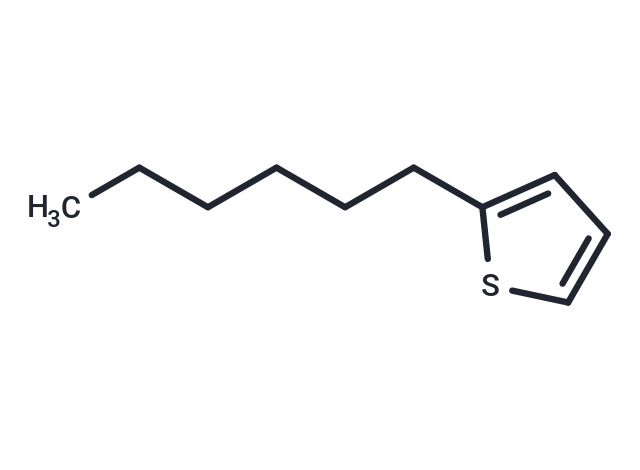
2-Hexylthiophene
CAS No. 18794-77-9
2-Hexylthiophene( —— )
Catalog No. M35106 CAS No. 18794-77-9
2-Hexylthiophene, a weakly basic heteroaromatic compound, can enhance the molar absorption coefficient of ruthenium sensitizers by undergoing modification.
Purity : >98% (HPLC)
 COA
Datasheet
HNMR
HPLC
MSDS
Handing Instructions
COA
Datasheet
HNMR
HPLC
MSDS
Handing Instructions
| Size | Price / USD | Stock | Quantity |
| 100MG | 27 | In Stock |


|
| 200MG | Get Quote | In Stock |
|
| 500MG | Get Quote | In Stock |
|
| 1G | Get Quote | In Stock |
|
Biological Information
-
Product Name2-Hexylthiophene
-
NoteResearch use only, not for human use.
-
Brief Description2-Hexylthiophene, a weakly basic heteroaromatic compound, can enhance the molar absorption coefficient of ruthenium sensitizers by undergoing modification.
-
Description2-Hexylthiophene is an extremely weak basic heteroaromatic compound. 2-Hexylthiophene can be used to modify and improve the molar absorption coefficient of ruthenium sensitizer
-
In Vitro2-Hexylthiophene is introduced to the 5-position of the terpyridine derivative ligand. And thereby, it helps to improve the molar absorption coefficient of ruthenium sensitizer.
-
In Vivo——
-
Synonyms——
-
PathwayOthers
-
TargetOther Targets
-
RecptorOthers
-
Research Area——
-
Indication——
Chemical Information
-
CAS Number18794-77-9
-
Formula Weight168.3
-
Molecular FormulaC10H16S
-
Purity>98% (HPLC)
-
SolubilityIn Vitro:?DMSO : 100 mg/mL (594.18 mM; Ultrasonic )
-
SMILESCCCCCCc1cccs1
-
Chemical Name——
Shipping & Storage Information
-
Storage(-20℃)
-
ShippingWith Ice Pack
-
Stability≥ 2 years
Reference
1. Ozawa H, et al. Ruthenium sensitizers with a hexylthiophene-modified terpyridine ligand for dye-sensitized solar cells: synthesis, photo- and electrochemical properties, and adsorption behavior to the TiO2 surface.ACS Appl Mater Interfaces.?2015 Feb 11;7(?
molnova catalog



related products
-
Tyrphostin 9
Tyrphostin 9 is an Agricultural acaricide, now superseded. Tyrphostin 9 is firstly designed as an EGFR inhibitor
-
MLS000532223
MLS000532223 is a selectiveRho family GTPases inhibitor(EC50 : 16 μM to 120 μM).
-
Psoralidin
Psoralidin inhibits Akt phosphorylation and phosphatidylinositol 3-kinase activation and transcriptionally.
