


 Cart
Cart
 sales@molnova.com


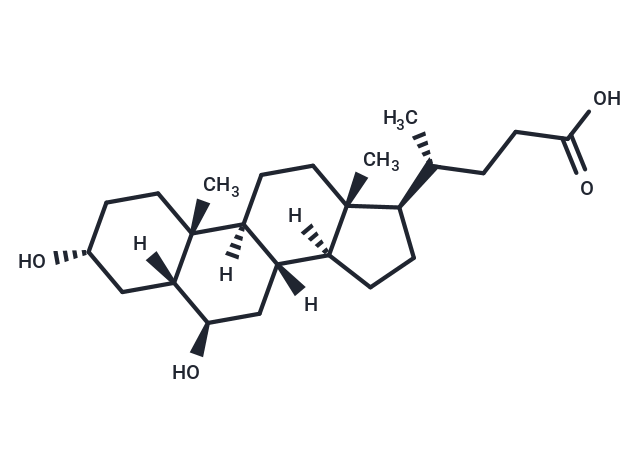
Murideoxycholic Acid
CAS No. 668-49-5
Murideoxycholic Acid( —— )
Catalog No. M34997 CAS No. 668-49-5
Murideoxycholic Acid alleviates non-alcoholic fatty liver disease by modulating the enterohepatic axis.
Purity : >98% (HPLC)
 COA
Datasheet
HNMR
HPLC
MSDS
Handing Instructions
COA
Datasheet
HNMR
HPLC
MSDS
Handing Instructions
| Size | Price / USD | Stock | Quantity |
| 2MG | 606 | Get Quote |


|
| 100MG | Get Quote | Get Quote |
|
| 200MG | Get Quote | Get Quote |
|
| 500MG | Get Quote | Get Quote |
|
| 1G | Get Quote | Get Quote |
|
Biological Information
-
Product NameMurideoxycholic Acid
-
NoteResearch use only, not for human use.
-
Brief DescriptionMurideoxycholic Acid alleviates non-alcoholic fatty liver disease by modulating the enterohepatic axis.
-
DescriptionMurideoxycholic acid is a 6 beta-hydroxylated bile acid.
-
In Vitro——
-
In Vivo——
-
Synonyms——
-
PathwayProteasome/Ubiquitin
-
TargetEndogenous Metabolite
-
RecptorEndogenous Metabolite
-
Research Area——
-
Indication——
Chemical Information
-
CAS Number668-49-5
-
Formula Weight392.57
-
Molecular FormulaC24H40O4
-
Purity>98% (HPLC)
-
Solubility——
-
SMILES[H][C@@]12CC[C@H]([C@H](C)CCC(O)=O)[C@@]1(C)CC[C@@]1([H])[C@@]2([H])C[C@@H](O)[C@]2([H])C[C@H](O)CC[C@]12C
-
Chemical Name——
Shipping & Storage Information
-
Storage(-20℃)
-
ShippingWith Ice Pack
-
Stability≥ 2 years
Reference
1. Khallou J, et al. Metabolism and time-course excretion of murideoxycholic acid, a 6 beta-hydroxylated bile acid, in humans. J Hepatol. 1993;17(3):364-372. ?
molnova catalog



related products
-
2'-Deoxyadenosine
2'-Deoxyadenosine is the DNA nucleoside A. It pairs with deoxythymidine (T) in double-stranded DNA.
-
Lactoferrin B
Lactoferrin is secreted by mammals and displays extensive biological effects including boosting the cold tolerance of a well-applied probiotic strain.
-
(R)-3-Hydroxybutanoi...
(R)-3-Hydroxybutanoic acid sodium ((R)-3-Hydroxybutyric acid) is a chiral precursor that can be used to synthesize biodegradable PHB and its copolyesters. (R)-3-Hydroxybutanoic acid sodium can be used as a nutrient in plants.
