


 Cart
Cart
 sales@molnova.com


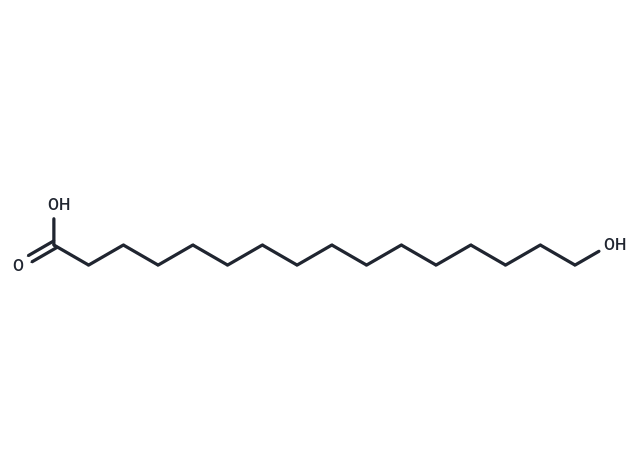
16-hydroxy Hexadecanoic Acid
CAS No. 506-13-8
16-hydroxy Hexadecanoic Acid( —— )
Catalog No. M34996 CAS No. 506-13-8
16-hydroxy Hexadecanoic Acid (Juniperic acid) is a compound isolated from the leaves and stems of Arabidopsis thaliana and can be used to prevent, alleviate, or treat metabolic diseases.
Purity : >98% (HPLC)
 COA
Datasheet
HNMR
HPLC
MSDS
Handing Instructions
COA
Datasheet
HNMR
HPLC
MSDS
Handing Instructions
| Size | Price / USD | Stock | Quantity |
| 1 mL x 10 mM in DMSO | 28 | In Stock |


|
| 100MG | 27 | In Stock |
|
| 200MG | Get Quote | In Stock |
|
| 500MG | Get Quote | In Stock |
|
| 1G | Get Quote | In Stock |
|
Biological Information
-
Product Name16-hydroxy Hexadecanoic Acid
-
NoteResearch use only, not for human use.
-
Brief Description16-hydroxy Hexadecanoic Acid (Juniperic acid) is a compound isolated from the leaves and stems of Arabidopsis thaliana and can be used to prevent, alleviate, or treat metabolic diseases.
-
Description16-hydroxy Hexadecanoic Acid (Juniperic acid) is a compound isolated from the leaves and stems of Arabidopsis thaliana and can be used to prevent, alleviate, or treat metabolic diseases.
-
In Vitro——
-
In Vivo——
-
Synonyms——
-
PathwayOthers
-
TargetOther Targets
-
RecptorOthers
-
Research Area——
-
Indication——
Chemical Information
-
CAS Number506-13-8
-
Formula Weight272.42
-
Molecular FormulaC16H32O3
-
Purity>98% (HPLC)
-
Solubility——
-
SMILESO=C(O)CCCCCCCCCCCCCCCO
-
Chemical Name——
Shipping & Storage Information
-
Storage(-20℃)
-
ShippingWith Ice Pack
-
Stability≥ 2 years
Reference
molnova catalog



related products
-
Fletikumab
Fletikumab (NNC0109-0012) is a monoclonal antibody that inhibits IL-20, primarily used in research on rheumatoid arthritis and psoriasis.
-
2-Hydroxychalcone B
2'-Hydroxychalcone is a drug synthesis intermediate for the synthesis of flavonoids. 2'-Hydroxychalcone loaded in nanoemulsion showed fungicidal activity against Coccidioides parapsilosis in Danio rerio model.
-
(S)-Ebalzotan
(S)-Ebalzotan is the S configuration of Ebalzotan.Ebalzotan is a 5-HT1A receptor agonist that is used in the study of depression.
