


 Cart
Cart
 sales@molnova.com


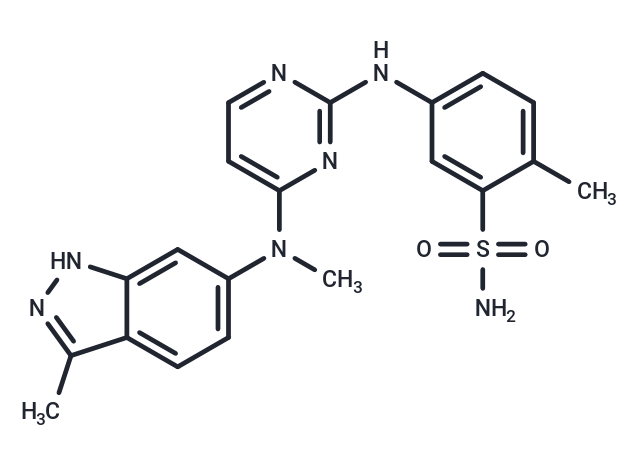
VEGFR-2-IN-6
CAS No. 444731-47-9
VEGFR-2-IN-6( —— )
Catalog No. M34911 CAS No. 444731-47-9
VEGFR-2-IN-6 (WO 02/059110, example 64) is a potent inhibitor of VEGFR2, a crucial receptor involved in the regulation of angiogenesis .
Purity : >98% (HPLC)
 COA
Datasheet
HNMR
HPLC
MSDS
Handing Instructions
COA
Datasheet
HNMR
HPLC
MSDS
Handing Instructions
| Size | Price / USD | Stock | Quantity |
| 1 mL x 10 mM in DMSO | 250 | In Stock |


|
| 5MG | 227 | In Stock |
|
| 10MG | 353 | In Stock |
|
| 100MG | Get Quote | In Stock |
|
| 200MG | Get Quote | In Stock |
|
| 500MG | Get Quote | In Stock |
|
| 1G | Get Quote | In Stock |
|
Biological Information
-
Product NameVEGFR-2-IN-6
-
NoteResearch use only, not for human use.
-
Brief DescriptionVEGFR-2-IN-6 (WO 02/059110, example 64) is a potent inhibitor of VEGFR2, a crucial receptor involved in the regulation of angiogenesis .
-
DescriptionVEGFR-2-IN-6 (example 64) is a VEGFR2 inhibitor (angiogenesis modulator), which is extracted from patent WO 02/059110.
-
In Vitro——
-
In Vivo——
-
Synonyms——
-
PathwayAngiogenesis
-
TargetVEGFR
-
RecptorVEGFR
-
Research Area——
-
Indication——
Chemical Information
-
CAS Number444731-47-9
-
Formula Weight423.49
-
Molecular FormulaC20H21N7O2S
-
Purity>98% (HPLC)
-
SolubilityIn Vitro:?DMSO : 25 mg/mL (59.03 mM; Ultrasonic )
-
SMILESCN(c1ccc2c(C)n[nH]c2c1)c1ccnc(Nc2ccc(C)c(c2)S(N)(=O)=O)n1
-
Chemical Name——
Shipping & Storage Information
-
Storage(-20℃)
-
ShippingWith Ice Pack
-
Stability≥ 2 years
Reference
1. Glaxo Wellcome House, et al. PYRIMIDINEAMINES AS ANGIOGENESIS MODULATORS. Patent WO 02/059110.
molnova catalog



related products
-
SAR131675
AR131675 is highly selective for VEGFR-3 versus 107 receptors, enzymes, ion channels, and 65 kinases.
-
Vatalanib free base
A potent, orally available class III receptor tyrosine kinases inhibitor with IC50 of <1 uM for VEGFR, Flt-1, KDR and PDGFRβ.
-
Apatinib Mesylate
Apatinib (YN968D1) is a multitargeted tyrosine kinase inhibitor (TKI) that inhibits VEGFR-2 (Flk-1/KDR, IC50=1 nM), RET, c-Kit and c-Src (IC50=13, 429 and 530 nM respectively).
