


 Cart
Cart
 sales@molnova.com


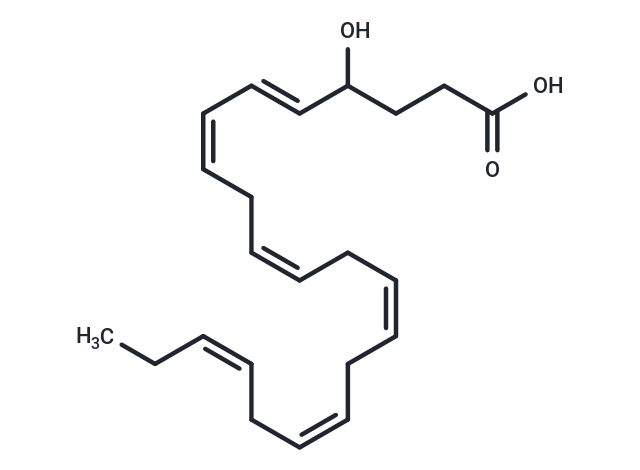
(±)4-HDHA
CAS No. 90906-40-4
(±)4-HDHA( —— )
Catalog No. M34865 CAS No. 90906-40-4
(±)4-HDHA (4-Hydroxy docosahexaenoic acid) is a PPARγ agonist with anti-inflammatory activity that directly inhibits endothelial cell proliferation and sprouting angiogenesis via PPARγ, which can be used in the study of diabetes.
Purity : >98% (HPLC)
 COA
Datasheet
HNMR
HPLC
MSDS
Handing Instructions
COA
Datasheet
HNMR
HPLC
MSDS
Handing Instructions
| Size | Price / USD | Stock | Quantity |
| 5MG | 3088 | In Stock |


|
| 10MG | 4171 | In Stock |
|
| 25MG | 6194 | In Stock |
|
| 100MG | Get Quote | In Stock |
|
| 200MG | Get Quote | In Stock |
|
| 500MG | Get Quote | In Stock |
|
| 1G | Get Quote | In Stock |
|
Biological Information
-
Product Name(±)4-HDHA
-
NoteResearch use only, not for human use.
-
Brief Description(±)4-HDHA (4-Hydroxy docosahexaenoic acid) is a PPARγ agonist with anti-inflammatory activity that directly inhibits endothelial cell proliferation and sprouting angiogenesis via PPARγ, which can be used in the study of diabetes.
-
Description(±)4-HDHA (4-Hydroxy docosahexaenoic acid) is a PPARγ agonist with anti-inflammatory activity that directly inhibits endothelial cell proliferation and sprouting angiogenesis via PPARγ, which can be used in the study of diabetes.
-
In Vitro——
-
In Vivo——
-
Synonyms——
-
PathwayMetabolic Enzyme/Protease
-
TargetPPAR
-
RecptorPPAR
-
Research Area——
-
Indication——
Chemical Information
-
CAS Number90906-40-4
-
Formula Weight344.49
-
Molecular FormulaC22H32O3
-
Purity>98% (HPLC)
-
Solubility——
-
SMILESC(=C/C(CCC(O)=O)O)\C=C/C/C=C\C/C=C\C/C=C\C/C=C\CC
-
Chemical Name——
Shipping & Storage Information
-
Storage(-20℃)
-
ShippingWith Ice Pack
-
Stability≥ 2 years
Reference
molnova catalog



related products
-
CUDA
CUDA is an effective soluble cyclohydrolase inhibitor with IC50 of 11.1 nM and 112 nM for mouse sEH and human sEH, respectively.
-
GSK3787
GSK3787 is as a selective and irreversible antagonist of PPARδ with pIC50 of 6.6, with no measurable affinity for hPPARα or hPPARγ.
-
Sakuranetin
Sakuranetin, a flavanone phytoalexin from ultraviolet-irradiated rice leaves, it has antifungal, antimutagenic, anti-inflammatory and antioxidant effects.
