


 Cart
Cart
 sales@molnova.com


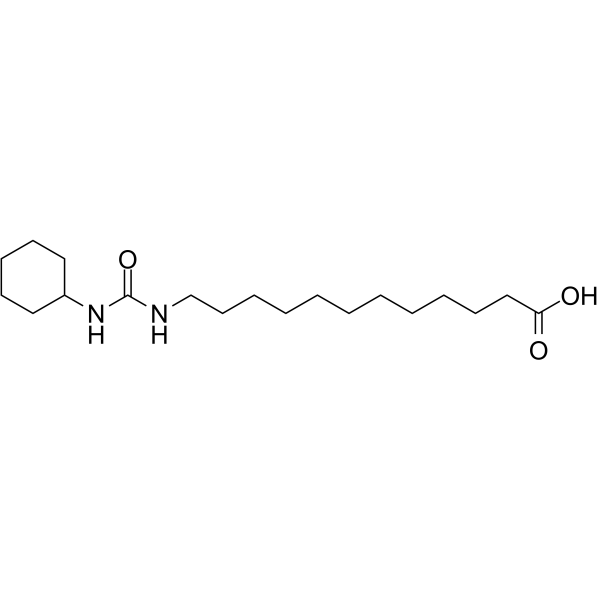
CUDA
CAS No. 479413-68-8
CUDA( —— )
Catalog No. M26131 CAS No. 479413-68-8
CUDA is an effective soluble cyclohydrolase inhibitor with IC50 of 11.1 nM and 112 nM for mouse sEH and human sEH, respectively.
Purity : >98% (HPLC)
 COA
Datasheet
HNMR
HPLC
MSDS
Handing Instructions
COA
Datasheet
HNMR
HPLC
MSDS
Handing Instructions
| Size | Price / USD | Stock | Quantity |
| 1 mL x 10 mM in DMSO | 43 | In Stock |


|
| 5MG | 39 | In Stock |
|
| 10MG | 63 | In Stock |
|
| 25MG | 125 | In Stock |
|
| 50MG | 204 | In Stock |
|
| 100MG | 327 | In Stock |
|
| 200MG | Get Quote | In Stock |
|
| 500MG | Get Quote | In Stock |
|
| 1G | Get Quote | In Stock |
|
Biological Information
-
Product NameCUDA
-
NoteResearch use only, not for human use.
-
Brief DescriptionCUDA is an effective soluble cyclohydrolase inhibitor with IC50 of 11.1 nM and 112 nM for mouse sEH and human sEH, respectively.
-
DescriptionCUDA is an effective soluble cyclohydrolase inhibitor with IC50 of 11.1 nM and 112 nM for mouse sEH and human sEH, respectively. CUDA selectively increases the activity of peroxisome proliferator-activated receptor (PPAR) alpha. CUDA may be valuable for the study of cardiovascular diseases.(In Vitro):CUDA (10 μM; 18 hours) produced a 6-fold and 3-fold increase of PPARalpha in COS-7 cells. CUDA does not change the expression of PPARalpha protein. It competitively inhibits the binding of Wy-14643 (pirinixic acid) to the ligand binding domain of PPARalpha, indicating that it acts as a PPARalpha ligand.
-
In VitroCUDA (10 μM; 18 hours) produces 6- and 3-fold increases of PPARalpha in COS-7 cells.CUDA does not alter PPARalpha protein expression, and it competitively inhibits the binding of Wy-14643 (pirinixic acid) to the ligand binding domain of PPARalpha, suggesting that it functions as a PPARalpha ligand. Western Blot Analysis Cell Line:COS-7 cells Concentration:10 μM Incubation Time:18 hours Result:Activated PPARα by binding to the ligand binding domain of PPARα.
-
In Vivo——
-
Synonyms——
-
PathwayMetabolic Enzyme/Protease
-
TargetPPAR
-
Recptor——
-
Research Area——
-
Indication——
Chemical Information
-
CAS Number479413-68-8
-
Formula Weight340.508
-
Molecular FormulaC19H36N2O3
-
Purity>98% (HPLC)
-
SolubilityIn Vitro:?DMSO : 25 mg/mL (73.42 mM)
-
SMILESOC(=O)CCCCCCCCCCCNC(=O)NC1CCCCC1
-
Chemical Name——
Shipping & Storage Information
-
Storage(-20℃)
-
ShippingWith Ice Pack
-
Stability≥ 2 years
Reference
1.Waterman C, Cheng DM, Rojas-Silva P, Poulev A, Dreifus J, Lila MA, Raskin I. Stable, water extractable isothiocyanates from Moringa oleifera leaves attenuate inflammation in vitro. Phytochemistry. 2014 Jul;103:114-122. doi: 10.1016/j.phytochem.2014.03.028. Epub 2014 Apr 11. PubMed PMID: 24731259; PubMed Central PMCID: PMC4071966.
molnova catalog



related products
-
Edoxudine
Edoxudine, an antiviral drug, is an analogue of thymidine and shows effectiveness against the herpes simplex virus.
-
Sulotroban
sulotroban is a TXA2 receptor antagonist that acts synergistically with iloprost to inhibit TXA2-dependent platelet activation.
-
Reglitazar
Reglitazar (JTT-501) is a dual PPARα and PPARγ agonist that is used to study diabetes.
