


 Cart
Cart
 sales@molnova.com


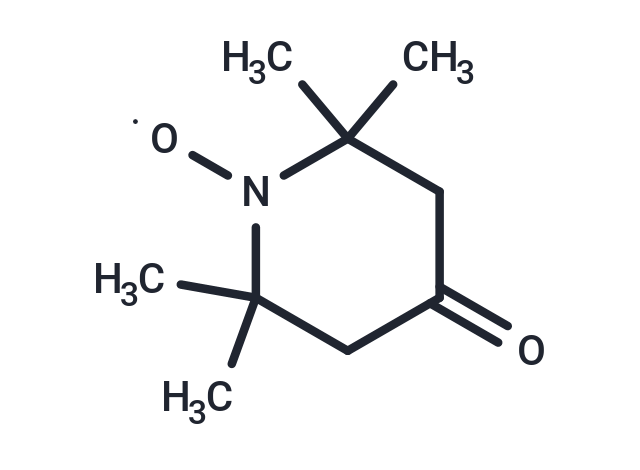
Tempone
CAS No. 2896-70-0
Tempone( —— )
Catalog No. M34851 CAS No. 2896-70-0
Tempone is an aminooxyalkane that acts as a free radical scavenger and reacts with reactive oxygen species (ROS). Intravenous Tempone reduces mean arterial pressure in spontaneously hypertensive rats.
Purity : >98% (HPLC)
 COA
Datasheet
HNMR
HPLC
MSDS
Handing Instructions
COA
Datasheet
HNMR
HPLC
MSDS
Handing Instructions
| Size | Price / USD | Stock | Quantity |
| 100MG | Get Quote | In Stock |


|
| 200MG | Get Quote | In Stock |
|
| 500MG | Get Quote | In Stock |
|
| 1G | 26 | In Stock |
|
Biological Information
-
Product NameTempone
-
NoteResearch use only, not for human use.
-
Brief DescriptionTempone is an aminooxyalkane that acts as a free radical scavenger and reacts with reactive oxygen species (ROS). Intravenous Tempone reduces mean arterial pressure in spontaneously hypertensive rats.
-
DescriptionTempone is an aminooxyalkane that acts as a free radical scavenger and reacts with reactive oxygen species (ROS). Intravenous Tempone reduces mean arterial pressure in spontaneously hypertensive rats.
-
In Vitro——
-
In Vivo——
-
Synonyms——
-
PathwayImmunology/Inflammation
-
TargetROS
-
RecptorROS
-
Research Area——
-
Indication——
Chemical Information
-
CAS Number2896-70-0
-
Formula Weight170.23
-
Molecular FormulaC9H16NO2
-
Purity>98% (HPLC)
-
Solubility——
-
SMILESCC1(C)CC(=O)CC(C)(C)N1[O]
-
Chemical Name——
Shipping & Storage Information
-
Storage(-20℃)
-
ShippingWith Ice Pack
-
Stability≥ 2 years
Reference
molnova catalog



related products
-
4-Aminophenol
4-Aminophenol (or para-aminophenol or p-aminophenol) is the organic compound with the formula H2NC6H4OH. Typically available as a white powder it is commonly used as a developer in black-and-white film marketed under the name Rodinal.
-
Blumeatin
Blumeatin has antioxidant properties, free radical scavenging activity,and has xanthine oxidase (XO) inhibitory activity.
-
CL097
CL097 is an effective agonist of TLR7 and TLR8. CL097 induces pro-inflammatory cytokines in macrophages and NADPH oxidase priming, thereby increasing the fMLF-stimulated ROS production.
