


 Cart
Cart
 sales@molnova.com


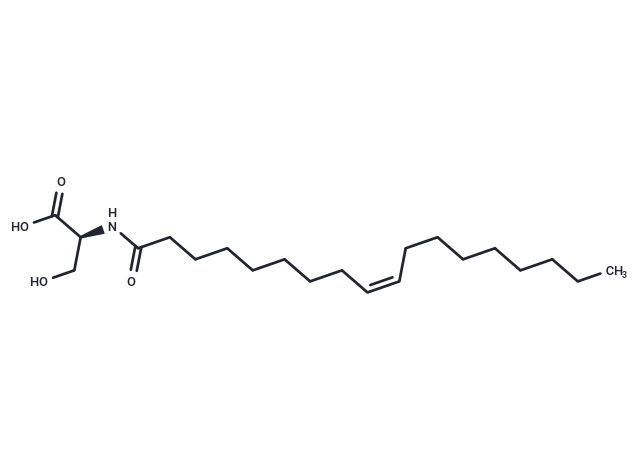
N-Oleoyl-L-Serine
CAS No. 107743-37-3
N-Oleoyl-L-Serine( —— )
Catalog No. M34817 CAS No. 107743-37-3
N-Oleoyl-L-Serine (N-Oleoylserine) is an endogenous long-chain fatty acid amide that is a lipid modulator of bone remodeling and stimulates osteoclast apoptosis which can be used to study osteoporosis.
Purity : >98% (HPLC)
 COA
Datasheet
HNMR
HPLC
MSDS
Handing Instructions
COA
Datasheet
HNMR
HPLC
MSDS
Handing Instructions
| Size | Price / USD | Stock | Quantity |
| 5MG | 185 | In Stock |


|
| 10MG | 328 | In Stock |
|
| 25MG | 554 | In Stock |
|
| 50MG | 775 | In Stock |
|
| 100MG | 1070 | In Stock |
|
| 200MG | 1442 | In Stock |
|
| 500MG | 2130 | In Stock |
|
| 1G | Get Quote | In Stock |
|
Biological Information
-
Product NameN-Oleoyl-L-Serine
-
NoteResearch use only, not for human use.
-
Brief DescriptionN-Oleoyl-L-Serine (N-Oleoylserine) is an endogenous long-chain fatty acid amide that is a lipid modulator of bone remodeling and stimulates osteoclast apoptosis which can be used to study osteoporosis.
-
DescriptionN-Oleoyl-L-Serine is an endogenous amide of long-chain fatty acids with ethanolamine (N-acyl amides). N-Oleoyl-L-Serine is a lipid regulator of bone remodeling and stimulates osteoclast apoptosis. N-Oleoyl-L-Serine can be used for antiosteoporotic drug discovery development.
-
In Vitro——
-
In Vivo——
-
Synonyms——
-
PathwayApoptosis
-
TargetApoptosis
-
RecptorApoptosis
-
Research Area——
-
Indication——
Chemical Information
-
CAS Number107743-37-3
-
Formula Weight369.54
-
Molecular FormulaC21H39NO4
-
Purity>98% (HPLC)
-
Solubility——
-
SMILESN([C@H](C(O)=O)CO)C(CCCCCCC/C=C\CCCCCCCC)=O
-
Chemical Name——
Shipping & Storage Information
-
Storage(-20℃)
-
ShippingWith Ice Pack
-
Stability≥ 2 years
Reference
1. Reem Smoum, et al. Oleoyl serine, an endogenous N-acyl amide, modulates bone remodeling and mass. Proc Natl Acad Sci U S A. 2010 Oct 12;107(41):17710-5.?
molnova catalog



related products
-
Azadirachtin
Azadirachtin has antifungal activity, used as an insecticide.
-
Silvestrol aglycone
Silvestrol is a potential anticancer rocaglate derivative from Aglaia foveolata, induces apoptosis in cancer cells through the mitochondrial/apoptosome pathway.
-
5-Benzylidene-3-ethy...
5-Benzylidene-3-ethyl rhodanine(BTR-1) is an active anti-cancer agent. BTR-1 activates apoptosis and induces cell death.
