


 Cart
Cart
 sales@molnova.com


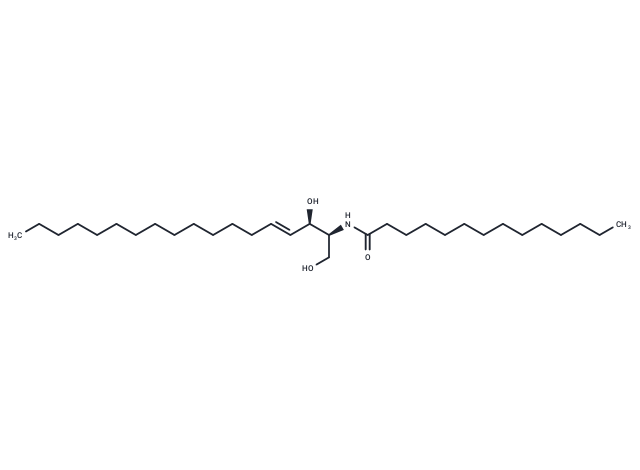
C14 Ceramide (d18:1/14:0)
CAS No. 34227-72-0
C14 Ceramide (d18:1/14:0)( —— )
Catalog No. M34790 CAS No. 34227-72-0
C14 Ceramide (d18:1/14:0) is an endogenous ceramide produced by ceramide synthetase 6, which can be used for Parkinson's research.
Purity : >98% (HPLC)
 COA
Datasheet
HNMR
HPLC
MSDS
Handing Instructions
COA
Datasheet
HNMR
HPLC
MSDS
Handing Instructions
| Size | Price / USD | Stock | Quantity |
| 2MG | 39 | In Stock |


|
| 5MG | 64 | In Stock |
|
| 10MG | 107 | In Stock |
|
| 25MG | 180 | In Stock |
|
| 50MG | 263 | In Stock |
|
| 100MG | 390 | In Stock |
|
| 200MG | 569 | In Stock |
|
| 500MG | Get Quote | In Stock |
|
| 1G | Get Quote | In Stock |
|
Biological Information
-
Product NameC14 Ceramide (d18:1/14:0)
-
NoteResearch use only, not for human use.
-
Brief DescriptionC14 Ceramide (d18:1/14:0) is an endogenous ceramide produced by ceramide synthetase 6, which can be used for Parkinson's research.
-
DescriptionC14 Ceramide (d18:1/14:0) is an endogenous ceramide produced by ceramide synthetase 6, which can be used for Parkinson's research.
-
In Vitro——
-
In Vivo——
-
Synonyms——
-
PathwayOthers
-
TargetOther Targets
-
RecptorOthers
-
Research Area——
-
Indication——
Chemical Information
-
CAS Number34227-72-0
-
Formula Weight509.85
-
Molecular FormulaC32H63NO3
-
Purity>98% (HPLC)
-
Solubility——
-
SMILESCCCCCCCCCCCCC\C=C\[C@@H](O)[C@H](CO)NC(=O)CCCCCCCCCCCCC
-
Chemical Name——
Shipping & Storage Information
-
Storage(-20℃)
-
ShippingWith Ice Pack
-
Stability≥ 2 years
Reference
molnova catalog



related products
-
GSK-626616
GSK-626616 is a potent and orally bioavailable DYRK3 inhibitor (IC50: 0.7 nM). It inhibits other members of the DYRK family with similar potency. GSK-626616 is a potential therapy for the treatment of anemia.
-
tri-GalNAc-COOH
Tri-GalNAc-COOH is a ligand for the asialoglycoprotein receptor (ASGPR) and is commonly used in lysosomal targeting chimera (LYTAC) investigations.
-
Nardosinone
Nardosinone has inhibitory effect on Ang II-induced hypertrophy in H9c2 cells, might be mediated by targeting PI3K/Akt and MEK/ERK signaling pathways.
