


 Cart
Cart
 sales@molnova.com


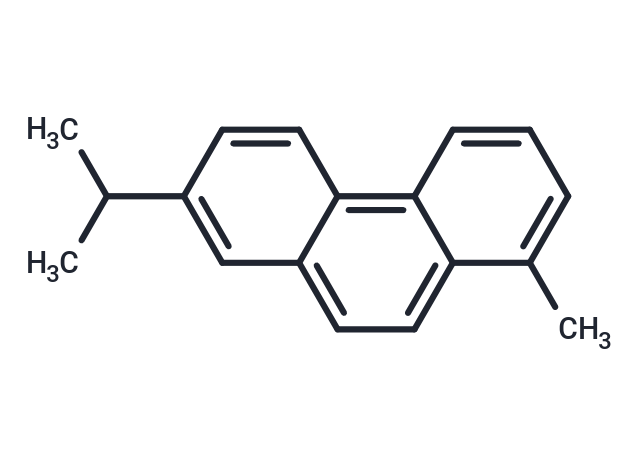
Retene
CAS No. 483-65-8
Retene( —— )
Catalog No. M34694 CAS No. 483-65-8
Retene (NSC-26317) is widely present in recent and ancient sediments, and compounds can be extracted from fir forest soils, humic coals, terrestrial petroleum hydrocarbon source rocks, and deep-sea sediments.Retene is produced by dehydrogenation of pine acids during petrogenesis.
Purity : >98% (HPLC)
 COA
Datasheet
HNMR
HPLC
MSDS
Handing Instructions
COA
Datasheet
HNMR
HPLC
MSDS
Handing Instructions
| Size | Price / USD | Stock | Quantity |
| 5MG | 390 | In Stock |


|
| 10MG | 567 | In Stock |
|
| 25MG | 924 | In Stock |
|
| 50MG | 1200 | In Stock |
|
| 100MG | 1646 | In Stock |
|
| 200MG | Get Quote | In Stock |
|
| 500MG | 3302 | In Stock |
|
| 1G | Get Quote | In Stock |
|
Biological Information
-
Product NameRetene
-
NoteResearch use only, not for human use.
-
Brief DescriptionRetene (NSC-26317) is widely present in recent and ancient sediments, and compounds can be extracted from fir forest soils, humic coals, terrestrial petroleum hydrocarbon source rocks, and deep-sea sediments.Retene is produced by dehydrogenation of pine acids during petrogenesis.
-
DescriptionRetene (NSC-26317) is widely present in recent and ancient sediments, and compounds can be extracted from fir forest soils, humic coals, terrestrial petroleum hydrocarbon source rocks, and deep-sea sediments.Retene is produced by dehydrogenation of pine acids during petrogenesis.
-
In Vitro——
-
In Vivo——
-
Synonyms——
-
PathwayOthers
-
TargetOther Targets
-
RecptorOthers
-
Research Area——
-
Indication——
Chemical Information
-
CAS Number483-65-8
-
Formula Weight234.34
-
Molecular FormulaC18H18
-
Purity>98% (HPLC)
-
Solubility——
-
SMILESCC=1C=2C(=C3C(C=C(C(C)C)C=C3)=CC2)C=CC1
-
Chemical Name——
Shipping & Storage Information
-
Storage(-20℃)
-
ShippingWith Ice Pack
-
Stability≥ 2 years
Reference
molnova catalog



related products
-
Lidocaine N-ethyl br...
Lidocaine N-ethyl bromide is a blocker of non-membrane-permeable,and Inhibits Acid-Induced Activation of Esophageal Nociceptive C Fiber Neurons.
-
Diosmin Impurity 5
Diosmin analog. Reference standards.
-
L-Selenocystine
L-Selenocystine can be used as a building block in biologically active selenol compounds.
