


 Cart
Cart
 sales@molnova.com


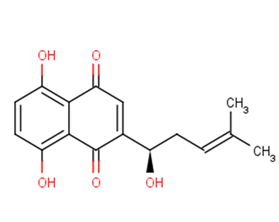
(+)-Shikonin
CAS No. 517-89-5
(+)-Shikonin( Shikonin | Tokyo Violet )
Catalog No. M18705 CAS No. 517-89-5
Shikonin is an TMEM16A chloride channel inhibitor (IC50: 6.5 μM). Shikonin is also a selective PKM2 inhibitor and can also suppress activation of the NF-κB pathway and inhibit TNF-α.
Purity : >98% (HPLC)
 COA
Datasheet
HNMR
HPLC
MSDS
Handing Instructions
COA
Datasheet
HNMR
HPLC
MSDS
Handing Instructions
| Size | Price / USD | Stock | Quantity |
| 1 mL x 10 mM in DMSO | 46 | In Stock |


|
| 5MG | 28 | In Stock |
|
| 10MG | 42 | In Stock |
|
| 25MG | 85 | In Stock |
|
| 50MG | 133 | In Stock |
|
| 100MG | 210 | In Stock |
|
| 200MG | 312 | In Stock |
|
| 500MG | 523 | In Stock |
|
| 1G | Get Quote | In Stock |
|
Biological Information
-
Product Name(+)-Shikonin
-
NoteResearch use only, not for human use.
-
Brief DescriptionShikonin is an TMEM16A chloride channel inhibitor (IC50: 6.5 μM). Shikonin is also a selective PKM2 inhibitor and can also suppress activation of the NF-κB pathway and inhibit TNF-α.
-
DescriptionShikonin is a natural product from the root of Lithospermum erythrorhizon and a specific inhibitor of pyruvate kinase M2 (PKM2). Shikonin also suppresses the ATF2 pathway in skin carcinogenesis.
-
In VitroShikonin is an inhibitor of TMEM16A chloride channel with an IC50 of 6.5 μM. Shikonin is also a specific inhibitor of PKM2 and can also inhibit tumor necrosis factor-α (TNF-α) and prevent activation of nuclear factor-κB (NF-κB) pathway. Shikonin at concentrations higher than 50 μM significantly inhibits ormal human keratinocytes (NHKs) viability, compare with that of control (P<0.05). Pretreatment with Shikonin for 2 h attenuates TNF-α-induced NF-κB p65 nuclear translocation. Treatments of Shikonin at 5 and 7.5 μM significantly inhibit the cell viability starting from 12 h and the inhibitory effects are presented in time-dependent patterns compare with the 0 h group in both cell lines. It is found that 5 μM Shikonin displays greater inhibition compare to 2.5 μM at the time points from 24 to 48 h.The invasiveness of U87 and U251 cells is significantly attenuated when treated with Shikonin at 2.5, 5, and 7.5 μM compare with the control group at 24 and 48 h (p<0.01).
-
In VivoShikonin significantly inhibits the increase in IL-1β and TNF-α expression levels in the rat model of osteoarthritis, compare with those in the osteoarthritis group (P<0.01). The NF-κB protein expression level is significantly suppressed by Shikonin in the rat model of osteoarthritis, compare with that in the osteoarthritis group (P<0.01).The induction of the iNOS level is suppressed by treatment with Shikonin in the rat model of osteoarthritis, compare with that in the osteoarthritis group (P<0.01). The administration of Shikonin markedly weakens the up-regulation of COX-2 protein expression in the rat model of osteoarthritis, as compare with that in the osteoarthritis group (P<0.01). The elevation of caspase-3 activity is significantly reduced by Shikonin treatment in the rat model of osteoarthritis, compare with that in the osteoarthritis group (P<0.01). The downregulation of Akt phosphorylation is also significantly recovered by treatment with Shikonin in the rat model of osteoarthritis, compare with that in the osteoarthritis group (P<0.01).
-
SynonymsShikonin | Tokyo Violet
-
PathwayOthers
-
TargetOther Targets
-
RecptorTMEM16A chloride channel|PKM2|NF-κB|TNF-α
-
Research AreaCancer
-
Indication——
Chemical Information
-
CAS Number517-89-5
-
Formula Weight288.3
-
Molecular FormulaC16H16O5
-
Purity>98% (HPLC)
-
SolubilityDMSO : ≥ 31 mg/mL; 107.53 mM
-
SMILESCC(C)=CCC(O)C1=CC(=O)c2c(O)ccc(O)c2C1=O
-
Chemical Name5,8-Dihydroxy-2-[(1R)-1-hydroxy-4-methylpent-3-enyl]naphthalene-1,4-dione
Shipping & Storage Information
-
Storage(-20℃)
-
ShippingWith Ice Pack
-
Stability≥ 2 years
Reference
1.Jiang Y, Yu B, Yang H, et al. Shikonin Inhibits Intestinal Calcium-Activated Chloride Channels and Prevents Rotaviral Diarrhea[J]. Frontiers in pharmacology, 2016, 7: 270.
molnova catalog



related products
-
(Z)-3-Hexenyl isoval...
(Z)-3-Hexenyl isovalerate ((3Z)-3-Hexen-1-yl 3-methylbutanoate) is a RIFM fragrance and one of the aroma components in Xinyang Maojian.
-
Cyanine5 NHS ester c...
Cyanine5 NHS ester chloride is a reactive dye with red fluorescence that requires a small amount of organic cosolvent (such as DMF or DMSO) to label amino groups in peptides, proteins, and oligonucleotides.
-
C12-Ceramide
C12-Ceramide (C12 Ceramide (d18:1/12:0)), a ceramide present in the protective membranes surrounding umbilical cord blood vessels in infants born to women with pre-eclampsia, can be used to assess the level of ASM activity in the plasma of patients with Niemann-Pick disease.
