


 Cart
Cart
 sales@molnova.com


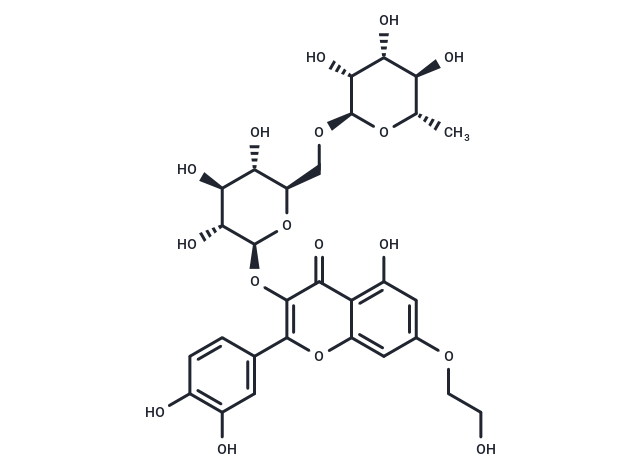
Monoxerutin
CAS No. 23869-24-1
Monoxerutin( —— )
Catalog No. M34656 CAS No. 23869-24-1
Monoxerutin (MonoHER) is a vasodilator with antioxidant activity that prevents adriamycin-induced cardiotoxicity in mice and is used in the study of acute respiratory syndrome.
Purity : >98% (HPLC)
 COA
Datasheet
HNMR
HPLC
MSDS
Handing Instructions
COA
Datasheet
HNMR
HPLC
MSDS
Handing Instructions
| Size | Price / USD | Stock | Quantity |
| 5MG | 686 | In Stock |


|
| 10MG | 938 | In Stock |
|
| 25MG | 1444 | In Stock |
|
| 50MG | 1841 | In Stock |
|
| 100MG | 2567 | In Stock |
|
| 200MG | Get Quote | In Stock |
|
| 500MG | Get Quote | In Stock |
|
| 1G | Get Quote | In Stock |
|
Biological Information
-
Product NameMonoxerutin
-
NoteResearch use only, not for human use.
-
Brief DescriptionMonoxerutin (MonoHER) is a vasodilator with antioxidant activity that prevents adriamycin-induced cardiotoxicity in mice and is used in the study of acute respiratory syndrome.
-
DescriptionMonoHER (7-Monohydroxyethylrutoside) is a Carbonyl reductase 1 (CBR1) inhibitor and can be used as a cardioprotective agent. MonoHER inhibits the activity of CBR1 V88 and CBR1 I88 in a concentration-dependent manner.
-
In Vitro——
-
In Vivo——
-
Synonyms——
-
PathwayOthers
-
TargetAntioxidant
-
RecptorAntioxidant
-
Research Area——
-
Indication——
Chemical Information
-
CAS Number23869-24-1
-
Formula Weight654.57
-
Molecular FormulaC29H34O17
-
Purity>98% (HPLC)
-
Solubility——
-
SMILESO(C1=C(OC=2C(C1=O)=C(O)C=C(OCCO)C2)C3=CC(O)=C(O)C=C3)[C@@H]4O[C@H](CO[C@H]5[C@H](O)[C@H](O)[C@@H](O)[C@H](C)O5)[C@@H](O)[C@H](O)[C@H]4O
-
Chemical Name——
Shipping & Storage Information
-
Storage(-20℃)
-
ShippingWith Ice Pack
-
Stability≥ 2 years
Reference
1. Gonzalez-Covarrubias V, et al. Inhibition of polymorphic human carbonyl reductase 1 (CBR1) by the cardioprotectant flavonoid 7-monohydroxyethyl rutoside (monoHER). Pharm Res. 2008 Jul;25(7):1730-4.?
molnova catalog



related products
-
Oxacillin sodium mon...
Oxacillin sodium monohydrate is an antibacterial agent and is a narrow spectrum beta-lactam antibiotic of the penicillin class.
-
BHT FCC NF
BHT is also used as an antioxidant additive in such diverse products as cosmetics, pharmaceuticals, rubber, electrical transformer oil.
-
Salviaflaside
Salviaflaside is the main bioactive component of Prunella vulgaris and has antioxidant activity.
