


 Cart
Cart
 sales@molnova.com


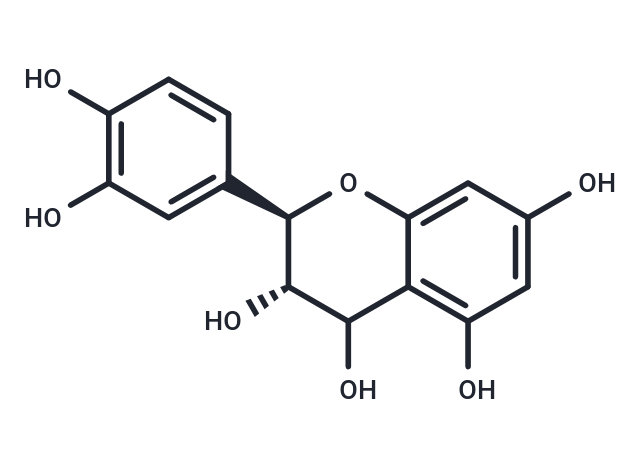
Leucocyanidin
CAS No. 480-17-1
Leucocyanidin( —— )
Catalog No. M34639 CAS No. 480-17-1
Leucocyanidin (Leucocianidol) is an antiulcer compound extracted from Aesculus Hippocastanum Seeds. Leucocyanidin can be used to study non-alcoholic fatty liver disease.
Purity : >98% (HPLC)
 COA
Datasheet
HNMR
HPLC
MSDS
Handing Instructions
COA
Datasheet
HNMR
HPLC
MSDS
Handing Instructions
| Size | Price / USD | Stock | Quantity |
| 2MG | 379 | In Stock |


|
| 100MG | Get Quote | In Stock |
|
| 200MG | Get Quote | In Stock |
|
| 500MG | Get Quote | In Stock |
|
| 1G | Get Quote | In Stock |
|
Biological Information
-
Product NameLeucocyanidin
-
NoteResearch use only, not for human use.
-
Brief DescriptionLeucocyanidin (Leucocianidol) is an antiulcer compound extracted from Aesculus Hippocastanum Seeds. Leucocyanidin can be used to study non-alcoholic fatty liver disease.
-
DescriptionLeucocyanidin is an active anti-ulcerogenic ingredient was extracted from Litchi Chinensis. Leucocyanidin demonstrates a significant protective effect against Aspirin-induced erosions in rat models.
-
In Vitro——
-
In Vivo——
-
Synonyms——
-
PathwayOthers
-
TargetOther Targets
-
RecptorOthers
-
Research Area——
-
Indication——
Chemical Information
-
CAS Number480-17-1
-
Formula Weight306.27
-
Molecular FormulaC15H14O7
-
Purity>98% (HPLC)
-
SolubilityIn Vitro:?DMSO : 100 mg/mL (326.51 mM; Ultrasonic )
-
SMILESOC1C=2C(O[C@@H]([C@H]1O)C3=CC(O)=C(O)C=C3)=CC(O)=CC2O
-
Chemical Name——
Shipping & Storage Information
-
Storage(-20℃)
-
ShippingWith Ice Pack
-
Stability≥ 2 years
Reference
1. D A Lewis, et al. A natural flavonoid present in unripe plantain banana pulp (Musa sapientum L. var. paradisiaca) protects the gastric mucosa from aspirin-induced erosions. J Ethnopharmacol. 1999 Jun;65(3):283-8.?
molnova catalog



related products
-
1-Methyl Emodin
1-O-Methylemodin is a nature product that could be isolated from Zopfiella longicaudata. 1-O-Methylemodin has antifungal activity.
-
D-Ala-Leu
D-Alanyl-L-leucine (D-Ala-Leu) is a dipeptide that acts as a source donor of L-Leucine.
-
NK01-63
NK01-63 (Coronastat) is a potent inhibitor of the SARS-CoV-2 3CL protease.
