


 Cart
Cart
 sales@molnova.com


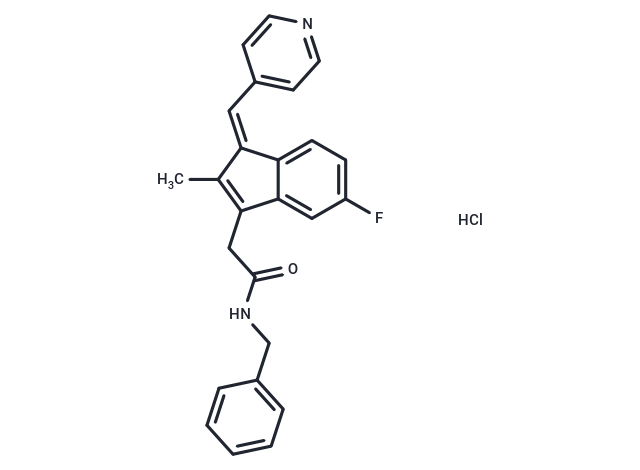
CP 461
CAS No. 227619-96-7
CP 461( —— )
Catalog No. M34553 CAS No. 227619-96-7
CP 461 (UNII-68OJX9I7DT), a specific PDE2A inhibitor, is a novel pro-apoptotic compound that inhibits cyclic GMP phosphodiesterase but not cyclooxygenase-1 or -2.
Purity : >98% (HPLC)
 COA
Datasheet
HNMR
HPLC
MSDS
Handing Instructions
COA
Datasheet
HNMR
HPLC
MSDS
Handing Instructions
| Size | Price / USD | Stock | Quantity |
| 5MG | 245 | In Stock |


|
| 10MG | 363 | In Stock |
|
| 25MG | 562 | In Stock |
|
| 50MG | 759 | In Stock |
|
| 100MG | 1014 | In Stock |
|
| 200MG | 1376 | In Stock |
|
| 500MG | Get Quote | In Stock |
|
| 1G | Get Quote | In Stock |
|
Biological Information
-
Product NameCP 461
-
NoteResearch use only, not for human use.
-
Brief DescriptionCP 461 (UNII-68OJX9I7DT), a specific PDE2A inhibitor, is a novel pro-apoptotic compound that inhibits cyclic GMP phosphodiesterase but not cyclooxygenase-1 or -2.
-
DescriptionCP 461 (UNII-68OJX9I7DT), a specific PDE2A inhibitor, is a novel pro-apoptotic compound that inhibits cyclic GMP phosphodiesterase but not cyclooxygenase-1 or -2. CP 461 inhibits the growth of a variety of human tumor cell lines in vitro and selectively induces apoptosis in cancer cell lines, but not in normal cells.
-
In Vitro——
-
In Vivo——
-
Synonyms——
-
PathwayApoptosis
-
TargetApoptosis
-
RecptorApoptosis | PDE
-
Research Area——
-
Indication——
Chemical Information
-
CAS Number227619-96-7
-
Formula Weight420.91
-
Molecular FormulaC25H22ClFN2O
-
Purity>98% (HPLC)
-
Solubility——
-
SMILESC(C(NCC1=CC=CC=C1)=O)C=2C=3C(/C(=C\C=4C=CN=CC4)/C2C)=CC=C(F)C3.Cl
-
Chemical Name——
Shipping & Storage Information
-
Storage(-20℃)
-
ShippingWith Ice Pack
-
Stability≥ 2 years
Reference
molnova catalog



related products
-
Snail/HDAC-IN-1
Snail/HDAC-IN-1 is a Snail/HDAC inhibitor with antimicrobial and anticancer activity, known to reduce Snail protein expression and induce apoptosis, making it useful for the study of solid tumors.
-
FMAU
FMAU (2'-Deoxy-2'-fluoro-5-methyl-beta-D-arabinouridine) is a thymine nucleoside analog with insertional activity on replicating DNA.FMAU can be used to label cells and track DNA synthesis.
-
VAS 3947
VAS 3947 is a specific inhibitor of NADPH oxidase (NOX).VAS 3947 has a potent anti-platelet effect, inducing apoptosis through UPR activation, mainly due to protein aggregation and misfolding, independent of anti-NOX activity.
