


 Cart
Cart
 sales@molnova.com


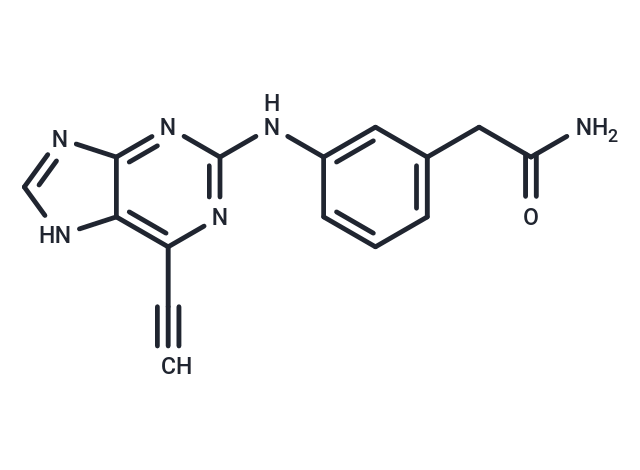
Nek2-IN-5
CAS No. 1507367-00-1
Nek2-IN-5( —— )
Catalog No. M34342 CAS No. 1507367-00-1
Nek2-IN-5 (NCL00017509) is a potent and selective inhibitor of NIMA-related kinase 2 (Nek2).
Purity : >98% (HPLC)
 COA
Datasheet
HNMR
HPLC
MSDS
Handing Instructions
COA
Datasheet
HNMR
HPLC
MSDS
Handing Instructions
| Size | Price / USD | Stock | Quantity |
| 5MG | 938 | In Stock |


|
| 10MG | 1321 | In Stock |
|
| 25MG | 1881 | In Stock |
|
| 50MG | 2595 | In Stock |
|
| 100MG | Get Quote | In Stock |
|
| 200MG | Get Quote | In Stock |
|
| 500MG | Get Quote | In Stock |
|
| 1G | Get Quote | In Stock |
|
Biological Information
-
Product NameNek2-IN-5
-
NoteResearch use only, not for human use.
-
Brief DescriptionNek2-IN-5 (NCL00017509) is a potent and selective inhibitor of NIMA-related kinase 2 (Nek2).
-
DescriptionNek2-IN-5 (compound 6) is a potent and irreversible Nek2 ((Never in mitosis gene a)-related kinase 2) inhibitior. Nek2-IN-5 is a click chemistry reagent, it contains an Alkyne group and can undergo copper-catalyzed azide-alkyne cycloaddition (CuAAc) with molecules containing Azide groups.
-
In Vitro——
-
In Vivo——
-
Synonyms——
-
PathwayMAPK/ERK Signaling
-
Targetp38 MAPK
-
RecptorMAPK
-
Research Area——
-
Indication——
Chemical Information
-
CAS Number1507367-00-1
-
Formula Weight292.3
-
Molecular FormulaC15H12N6O
-
Purity>98% (HPLC)
-
Solubility——
-
SMILESC(#C)C1=C2C(=NC(NC3=CC(CC(N)=O)=CC=C3)=N1)N=CN2
-
Chemical Name——
Shipping & Storage Information
-
Storage(-20℃)
-
ShippingWith Ice Pack
-
Stability≥ 2 years
Reference
1. Lebraud H, et al. Model system for irreversible inhibition of Nek2: thiol addition to ethynylpurines and related substituted heterocycles. Org Biomol Chem. 2014 Jan 7;12(1):141-8. ?
molnova catalog



related products
-
VX-745
A potent and selective p38α kinase inhibitor with IC50 of 9 nM; shows 20-fold selectivity for p38α over p38β (Ki=220 nM) and no significant inhibition for MAP kinases (with the exception of MKK6).
-
sodium lauroyl-α-hyd...
Sodium houttuyfonate is anti-pseudomonas agents inhibits virulence-related motility of Pseudomonas.
-
Tenacissoside G
Tenacissoside G is a C21 steroid from the stems of Marsdenia tenacissima.
