


 Cart
Cart
 sales@molnova.com


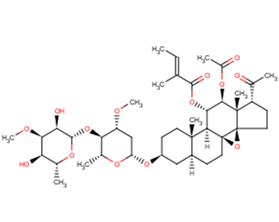
Tenacissoside G
CAS No. 191729-43-8
Tenacissoside G( —— )
Catalog No. M18173 CAS No. 191729-43-8
Tenacissoside G is a C21 steroid from the stems of Marsdenia tenacissima.
Purity : >98% (HPLC)
 COA
Datasheet
HNMR
HPLC
MSDS
Handing Instructions
COA
Datasheet
HNMR
HPLC
MSDS
Handing Instructions
| Size | Price / USD | Stock | Quantity |
| 1 mL x 10 mM in DMSO | 83 | In Stock |


|
| 2MG | 30 | In Stock |
|
| 5MG | 48 | In Stock |
|
| 10MG | 81 | In Stock |
|
| 25MG | 132 | In Stock |
|
| 100MG | Get Quote | In Stock |
|
| 200MG | Get Quote | In Stock |
|
| 500MG | Get Quote | In Stock |
|
| 1G | Get Quote | In Stock |
|
Biological Information
-
Product NameTenacissoside G
-
NoteResearch use only, not for human use.
-
Brief DescriptionTenacissoside G is a C21 steroid from the stems of Marsdenia tenacissima.
-
DescriptionTenacissoside G is a C21 steroid from the stems of Marsdenia tenacissima. Tenacissoside G reverses multidrug resistance in P-glycoprotein (Pgp)-overexpressing multidrug-resistant cancer cells.
-
In Vitro——
-
In Vivo——
-
Synonyms——
-
PathwayMAPK/ERK Signaling
-
Targetp38 MAPK
-
RecptorOthers
-
Research Area——
-
Indication——
Chemical Information
-
CAS Number191729-43-8
-
Formula Weight792.96
-
Molecular FormulaC42H64O14
-
Purity>98% (HPLC)
-
SolubilityIn Vitro:?DMSO : 100 mg/mL (126.11 mM)
-
SMILESCC=C(C)C(=O)OC1C2C3(CCC(CC3CCC24C5(O4)CCC(C5(C1OC(=O)C)C)C(=O)C)OC6CC(C(C(O6)C)OC7C(C(C(C(O7)C)O)OC)O)OC)C
-
Chemical Name——
Shipping & Storage Information
-
Storage(-20℃)
-
ShippingWith Ice Pack
-
Stability≥ 2 years
Reference
molnova catalog



related products
-
SB 203580 hydrochlor...
A specific p38 MAPK inhibitor with IC50 of 0.6 uM.
-
Ginkgolide A
Ginkgolide A is a highly active PAF antagonist cage molecule that is isolated from the leaves of the Ginkgo biloba tree. Shows potential in a wide variety of inflammatory and immunological disorders.
-
APS6-45
APS6-45 inhibits RAS/MAPK signaling and exhibits anti-tumor activity.
