


 Cart
Cart
 sales@molnova.com


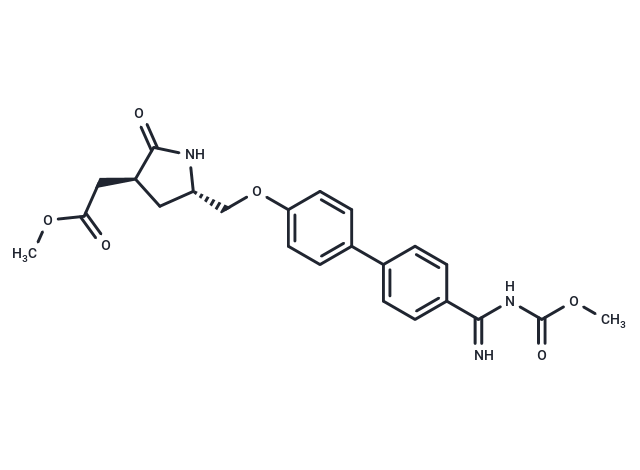
Lefradafiban
CAS No. 149503-79-7
Lefradafiban( —— )
Catalog No. M34312 CAS No. 149503-79-7
Lefradafiban(BIBU-104) is an oral platelet glycoprotein IIb/IIIa receptor antagonist for the study of angina pectoris and acute coronary syndromes.
Purity : >98% (HPLC)
 COA
Datasheet
HNMR
HPLC
MSDS
Handing Instructions
COA
Datasheet
HNMR
HPLC
MSDS
Handing Instructions
| Size | Price / USD | Stock | Quantity |
| 5MG | 472 | In Stock |


|
| 10MG | 656 | In Stock |
|
| 25MG | 950 | In Stock |
|
| 100MG | Get Quote | In Stock |
|
| 200MG | Get Quote | In Stock |
|
| 500MG | Get Quote | In Stock |
|
| 1G | Get Quote | In Stock |
|
Biological Information
-
Product NameLefradafiban
-
NoteResearch use only, not for human use.
-
Brief DescriptionLefradafiban(BIBU-104) is an oral platelet glycoprotein IIb/IIIa receptor antagonist for the study of angina pectoris and acute coronary syndromes.
-
DescriptionLefradafiban(BIBU-104) is an oral platelet glycoprotein IIb/IIIa receptor antagonist for the study of angina pectoris and acute coronary syndromes.
-
In Vitro——
-
In Vivo——
-
Synonyms——
-
PathwayOthers
-
TargetOther Targets
-
RecptorOthers
-
Research Area——
-
Indication——
Chemical Information
-
CAS Number149503-79-7
-
Formula Weight439.46
-
Molecular FormulaC23H25N3O6
-
Purity>98% (HPLC)
-
Solubility——
-
SMILESC(NC(OC)=O)(=N)C1=CC=C(C=C1)C2=CC=C(OC[C@@H]3C[C@@H](CC(OC)=O)C(=O)N3)C=C2
-
Chemical Name——
Shipping & Storage Information
-
Storage(-20℃)
-
ShippingWith Ice Pack
-
Stability≥ 2 years
Reference
molnova catalog



related products
-
Gentisein
Gentisein, the major metabolite of Mangiferin, shows the most potent serotonin uptake inhibition with an IC50 value of 4.7 μM.
-
2-O-Galloylquercitri...
2''-O-Galloylquercitrin is a natural product from Acer ginnala.
-
KL-22
KL-22
