


 Cart
Cart
 sales@molnova.com


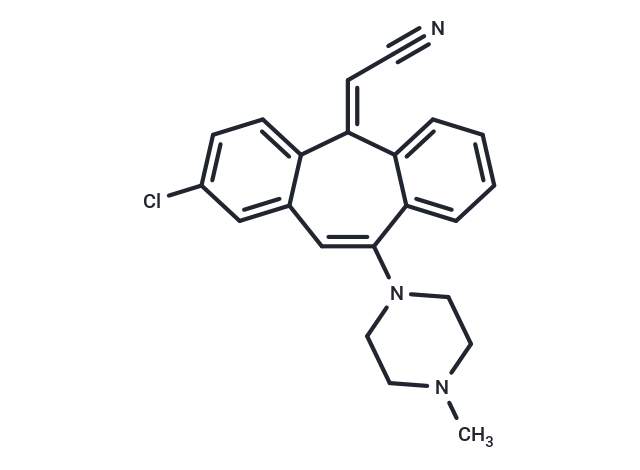
Rilapine
CAS No. 79781-95-6
Rilapine( —— )
Catalog No. M34128 CAS No. 79781-95-6
Rilapine (Rilapinum) is an antipsychotic compound that shows high affinity for 5-HT6 receptors and can be used to study neurological disorders.
Purity : >98% (HPLC)
 COA
Datasheet
HNMR
HPLC
MSDS
Handing Instructions
COA
Datasheet
HNMR
HPLC
MSDS
Handing Instructions
| Size | Price / USD | Stock | Quantity |
| 5MG | 686 | In Stock |


|
| 10MG | 938 | In Stock |
|
| 25MG | 1444 | In Stock |
|
| 50MG | 1841 | In Stock |
|
| 100MG | Get Quote | In Stock |
|
| 200MG | Get Quote | In Stock |
|
| 500MG | Get Quote | In Stock |
|
| 1G | Get Quote | In Stock |
|
Biological Information
-
Product NameRilapine
-
NoteResearch use only, not for human use.
-
Brief DescriptionRilapine (Rilapinum) is an antipsychotic compound that shows high affinity for 5-HT6 receptors and can be used to study neurological disorders.
-
DescriptionRilapine is an atypical antipsychotic agent.
-
In Vitro——
-
In Vivo——
-
Synonyms——
-
PathwayGPCR/G Protein
-
Target5-HT Receptor
-
Recptor5-HT Receptor
-
Research Area——
-
Indication——
Chemical Information
-
CAS Number79781-95-6
-
Formula Weight361.87
-
Molecular FormulaC22H20ClN3
-
Purity>98% (HPLC)
-
Solubility——
-
SMILESC(\C#N)=C/1\C=2C(C(=CC=3C1=CC=C(Cl)C3)N4CCN(C)CC4)=CC=CC2
-
Chemical Name——
Shipping & Storage Information
-
Storage(-20℃)
-
ShippingWith Ice Pack
-
Stability≥ 2 years
Reference
1. Zeng XP, et al. Muscarinic m4 receptor activation by some atypical antipsychotic drugs. Eur J Pharmacol. 1997 Mar 5;321(3):349-54.?
molnova catalog



related products
-
E-3620
E-3620 is a novel 5-HT3 receptor antagonist that inhibits cisplatin-induced vomiting in beagles. E-3620 can be used to study dyskinesia, gastrointestinal dyskinesia, psoriasis and psoriasis.
-
BMY-14802 hydrochlor...
BMY-14802 hydrochloride (BMS 181100 hydrochloride) is a selective antagonist of σ receptor (IC50 = 112 nM) with antipsychotic effects. BMY-14802 hydrochloride is an agonist of the α1-adrenergic receptor and 5-HT1A.
-
(Rac)-Norcisapride
Norcisapride is a 5-hydroxytryptamine receptor 3 (5-HT3) and (5-hydroxytryptamine receptor 4 (5-HT4) dual agonist used for the treatment of gastrointestinal disorders, orofacial disorders, and otorhinolaryngologic disorders.
