


 Cart
Cart
 sales@molnova.com


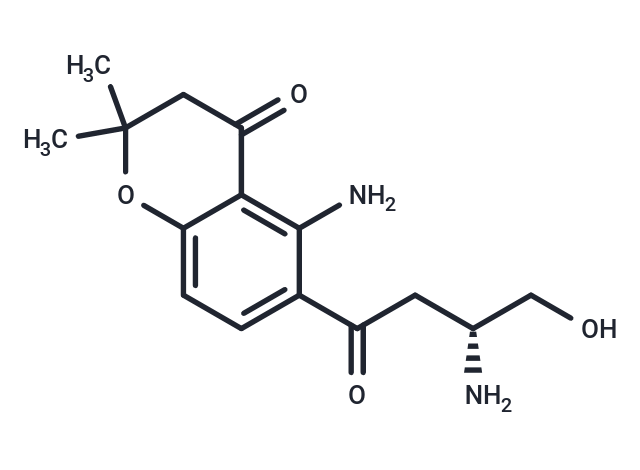
Fusarochromanone
CAS No. 802915-53-3
Fusarochromanone( —— )
Catalog No. M33984 CAS No. 802915-53-3
Fusarochromanone (FC-101) is a mycotoxin produced by Fusarium marcescens with potent antiangiogenic, anticancer and antimalarial activities.
Purity : >98% (HPLC)
 COA
Datasheet
HNMR
HPLC
MSDS
Handing Instructions
COA
Datasheet
HNMR
HPLC
MSDS
Handing Instructions
| Size | Price / USD | Stock | Quantity |
| 5MG | 1074 | In Stock |


|
| 10MG | 1444 | In Stock |
|
| 25MG | 2138 | In Stock |
|
| 50MG | 2762 | In Stock |
|
| 100MG | Get Quote | In Stock |
|
| 200MG | Get Quote | In Stock |
|
| 500MG | Get Quote | In Stock |
|
| 1G | Get Quote | In Stock |
|
Biological Information
-
Product NameFusarochromanone
-
NoteResearch use only, not for human use.
-
Brief DescriptionFusarochromanone (FC-101) is a mycotoxin produced by Fusarium marcescens with potent antiangiogenic, anticancer and antimalarial activities.
-
DescriptionFusarochromanone (FC-101) is a fungal metabolite with potent anti-angiogenic and anti-cancer activity. Fusarochromanone-activated JNK pathway is attributed to induction of reactive oxygen species (ROS).
-
In VitroFusarochromanone (FC101; 10 μM; 24 hours) induces apoptosis and an increase in proportion of cells in the sub-G1 phase in both HaCat and P9-WT cell lines. Fusarochromanone (FC101; 0-1 μM; 24 h) induces the cleavage of both caspase-3 and PARP, a well-known substrate for activated caspases. FC101 does not affect the expression of the anti-apoptotic proteins, Bcl-2, Bcl-XL, Mcl-1, or the pro-apoptotic proteins BAD, BAK, BAX.Fusarochromanone (FC101) exhibits very potent in-vitro growth inhibitory effects (IC50 ranging from 10 nM-2.5 μM) against HaCat (pre-malignant skin), P9-WT (malignant skin), MCF-7 (low malignant breast), MDA-231 (malignant breast), SV-HUC (premalignant bladder), UM-UC14 (malignant bladder), and PC3 (malignant prostate) in a time-course and dose-dependent manner, with the UM-UC14 cells being the most sensitive.Cell Cycle Analysis Cell Line:HaCat and P9-WT cell lines Concentration:10 μM Incubation Time:24 hours Result:Showed cells in the G2 and M phases of the cell cycle for both cell lines.Western Blot Analysis Cell Line:MDA-MB-231 cells Concentration:0.05 μM, 0.1 μM, 0.2 μM, 0.5 μM, 1 μM Incubation Time:24 hours Result:Induced the cleavage of both caspase-3 and PARP.
-
In VivoFusarochromanone (8 mg/kg; IP; 5 days per week; for 3.5 weeks) Is well tolerated, non-toxic, and achieved a 30% reduction in tumor size at a dose of 8 mg/kg/day.Animal Model:SCID Beige mice (CB17/Icr.Cg-PrkdcscidLystbg/Crl) injected with SRB12-p9 cells Dosage:8 mg/kg Administration:IP; 5 days per week; for 3.5 weeks Result:Achieved a 30% reduction in tumor size at a dose of 8 mg/kg/day.
-
Synonyms——
-
PathwayOthers
-
TargetOther Targets
-
RecptorReactive Oxygen Species
-
Research Area——
-
Indication——
Chemical Information
-
CAS Number802915-53-3
-
Formula Weight292.33
-
Molecular FormulaC15H20N2O4
-
Purity>98% (HPLC)
-
Solubility——
-
SMILESNC1=C2C(=CC=C1C(C[C@H](CO)N)=O)OC(C)(C)CC2=O
-
Chemical Name——
Shipping & Storage Information
-
Storage(-20℃)
-
ShippingWith Ice Pack
-
Stability≥ 2 years
Reference
1. Elahe Mahdavian, et al.Biological activities of fusarochromanone: a potent anti-cancer agent. BMC Res Notes. 2014 Sep 3;7:601.?
molnova catalog



related products
-
Malvidin-3-O-rutinos...
Malvidin-3-O-rutinoside
-
Cefuroxime sodium
Cefuroxime sodium is an enteral or oral second-generation cephalosporin antibiotic.
-
3-Methyl-2-buten-1-o...
Prenol is found in blackcurrant. Prenol is a constituent of ylang-ylang and hop oils. Prenol is found in orange peel oil and various fruits e.g. orange lemon lime grape pineapple purple passion fruit loganberry etc. Prenol is a flavouring ingredient
