


 Cart
Cart
 sales@molnova.com


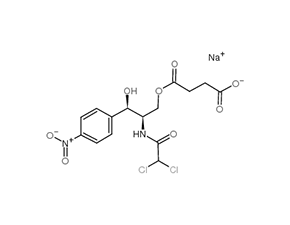
Chloramphenicol sodium succinate
CAS No. 982-57-0
Chloramphenicol sodium succinate( Chloramphenicol succinate sodium )
Catalog No. M21352 CAS No. 982-57-0
Chloramphenicol sodium succinate is broad-spectrum antibiotic with antibacterial activity.
Purity : >98% (HPLC)
 COA
Datasheet
HNMR
HPLC
MSDS
Handing Instructions
COA
Datasheet
HNMR
HPLC
MSDS
Handing Instructions
| Size | Price / USD | Stock | Quantity |
| 1 mL x 10 mM in DMSO | 29 | In Stock |


|
| 100MG | 27 | In Stock |
|
| 200MG | Get Quote | In Stock |
|
| 500MG | Get Quote | In Stock |
|
| 1G | Get Quote | In Stock |
|
Biological Information
-
Product NameChloramphenicol sodium succinate
-
NoteResearch use only, not for human use.
-
Brief DescriptionChloramphenicol sodium succinate is broad-spectrum antibiotic with antibacterial activity.
-
DescriptionChloramphenicol sodium succinate is broad-spectrum antibiotic with antibacterial activity.
-
In Vitro——
-
In Vivo——
-
SynonymsChloramphenicol succinate sodium
-
PathwayOthers
-
TargetOther Targets
-
RecptorOthers
-
Research Area——
-
Indication——
Chemical Information
-
CAS Number982-57-0
-
Formula Weight445.2
-
Molecular FormulaC15H15Cl2N2NaO8
-
Purity>98% (HPLC)
-
SolubilityDMSO:89 mg/mL (199.91 mM)
-
SMILESC1=CC(=CC=C1[C@H]([C@@H](CO)NC(=O)C(Cl)Cl)O)[N+](=O)[O-]
-
Chemical Name——
Shipping & Storage Information
-
Storage(-20℃)
-
ShippingWith Ice Pack
-
Stability≥ 2 years
Reference
1.Ambekar C S Lee J S K Cheung B M Y et al. Chloramphenicol succinate a competitive substrate and inhibitor of succinate dehydrogenase: possible reason for its toxicity[J]. Toxicology in Vitro 2004 18(4):0-447.
molnova catalog



related products
-
trans-2-Decenoic aci...
Trans-2-Decenoic acid is an unsaturated fatty acid found in royal jelly produced from the hypopharyngeal and mandibular gland secretions of honeybees.
-
AK301
AK301 is a potent and selective inhibitor of tubulin polymerization and an effective sensitizer of cancer cells to apoptotic ligands (EC50 < 200 nM).
-
m-PEG3-SH
m-PEG3-SH is a PEG-based PROTAC linker that can be used in the synthesis of PROTACs.
