


 Cart
Cart
 sales@molnova.com


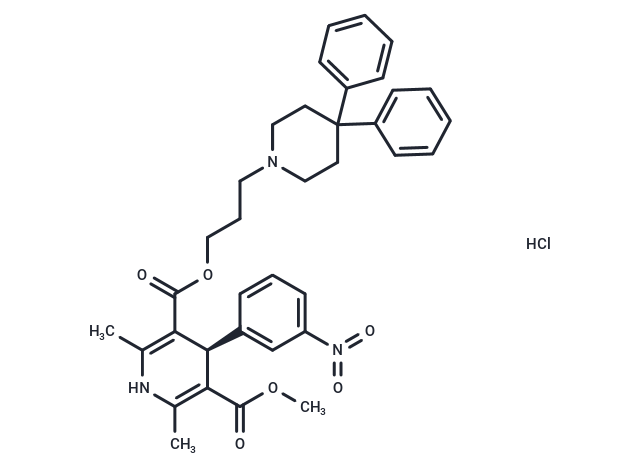
(S)-(+)-Niguldipine hydrochloride
CAS No. 113145-69-0
(S)-(+)-Niguldipine hydrochloride( —— )
Catalog No. M33919 CAS No. 113145-69-0
(S)-(+)-Niguldipine hydrochloride is a selective α1A-AR antagonist used in the study of depression and epilepsy.
Purity : >98% (HPLC)
 COA
Datasheet
HNMR
HPLC
MSDS
Handing Instructions
COA
Datasheet
HNMR
HPLC
MSDS
Handing Instructions
| Size | Price / USD | Stock | Quantity |
| 5MG | 170 | In Stock |


|
| 10MG | 250 | In Stock |
|
| 25MG | 588 | In Stock |
|
| 50MG | 1004 | In Stock |
|
| 100MG | 1349 | In Stock |
|
| 200MG | Get Quote | In Stock |
|
| 500MG | 2688 | In Stock |
|
| 1G | Get Quote | In Stock |
|
Biological Information
-
Product Name(S)-(+)-Niguldipine hydrochloride
-
NoteResearch use only, not for human use.
-
Brief Description(S)-(+)-Niguldipine hydrochloride is a selective α1A-AR antagonist used in the study of depression and epilepsy.
-
Description(S)-(+)-Niguldipine hydrochloride is a selective α1A-AR antagonist used in the study of depression and epilepsy.
-
In Vitro——
-
In Vivo——
-
Synonyms——
-
PathwayGPCR/G Protein
-
TargetAdrenergic Receptor
-
RecptorAdrenergic Receptor
-
Research Area——
-
Indication——
Chemical Information
-
CAS Number113145-69-0
-
Formula Weight646.17
-
Molecular FormulaC36H40ClN3O6
-
Purity>98% (HPLC)
-
Solubility——
-
SMILESC(CCOC(=O)C=1[C@H](C(C(OC)=O)=C(C)NC1C)C2=CC(N(=O)=O)=CC=C2)N3CCC(CC3)(C4=CC=CC=C4)C5=CC=CC=C5.Cl
-
Chemical Name——
Shipping & Storage Information
-
Storage(-20℃)
-
ShippingWith Ice Pack
-
Stability≥ 2 years
Reference
molnova catalog



related products
-
OPC-28326
OPC-28326 is a specific an α2-adrenergic receptor antagonist and acts as a peripheral vasodilator. OPC-28326 inhibits α2A-, α2B- and α2C-adrenoceptors with Ki of 2040, 285, and 55?nM, respectively.
-
Besipirdine
Besipirdine (HP 749 free base) is a non-receptor-dependent cholinomimetic compound with alpha-adrenergic and cardiovascular activities.
-
Silodosin
A highly potent, uroselective α1a-adrenoceptor antagonist with Ki of 36 pM; displays 583- and 56-fold lower potency against α1b and α1d respectors, respectively.
