


 Cart
Cart
 sales@molnova.com


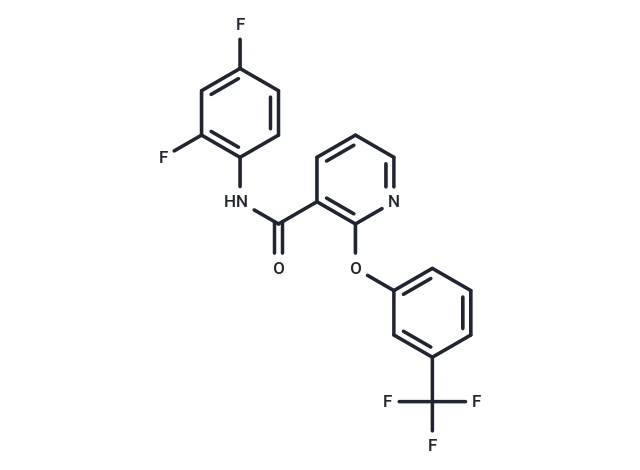
Diflufenican
CAS No. 83164-33-4
Diflufenican( —— )
Catalog No. M33703 CAS No. 83164-33-4
Diflufenican (M&B 38544) increases the production of phytoene in carrot cell cultures by inducing the inhibition of phytoene desaturase gene expression.
Purity : >98% (HPLC)
 COA
Datasheet
HNMR
HPLC
MSDS
Handing Instructions
COA
Datasheet
HNMR
HPLC
MSDS
Handing Instructions
| Size | Price / USD | Stock | Quantity |
| 100MG | Get Quote | In Stock |


|
| 200MG | Get Quote | In Stock |
|
| 500MG | Get Quote | In Stock |
|
| 1G | 47 | In Stock |
|
Biological Information
-
Product NameDiflufenican
-
NoteResearch use only, not for human use.
-
Brief DescriptionDiflufenican (M&B 38544) increases the production of phytoene in carrot cell cultures by inducing the inhibition of phytoene desaturase gene expression.
-
DescriptionDiflufenican is a contact, selective herbicide used to specifically control some broad leaved weeds.
-
In Vitro——
-
In Vivo——
-
Synonyms——
-
PathwayOthers
-
TargetOther Targets
-
RecptorOthers
-
Research Area——
-
Indication——
Chemical Information
-
CAS Number83164-33-4
-
Formula Weight394.29
-
Molecular FormulaC19H11F5N2O2
-
Purity>98% (HPLC)
-
SolubilityIn Vitro:?DMSO : 66.67 mg/mL (169.09 mM; Ultrasonic )
-
SMILESFC1=CC(F)=C(NC(=O)C2=C(OC3=CC=CC(=C3)C(F)(F)F)N=CC=C2)C=C1
-
Chemical Name——
Shipping & Storage Information
-
Storage(-20℃)
-
ShippingWith Ice Pack
-
Stability≥ 2 years
Reference
1. P Kosubová ,et al. Spatial and Temporal Distribution of the Currently-Used and Recently-Banned Pesticides in Arable Soils of the Czech Republic. Chemosphere. 2020 Sep;254:126902.?
molnova catalog



related products
-
8-Hydroxybergapten
8-Hydroxybergapten may have anti-wrinkle activity.
-
UDP-6-azido-6-deoxy-...
UDP-6-azido-6-deoxy-D-glucose is a chemical building block that is used for saccharide synthesis.
-
11-Aminoundecanoic a...
11-Aminoundecanoic acid is an alkyl chain based PROTAC linker can be used in the synthesis of PROTACs.
