


 Cart
Cart
 sales@molnova.com


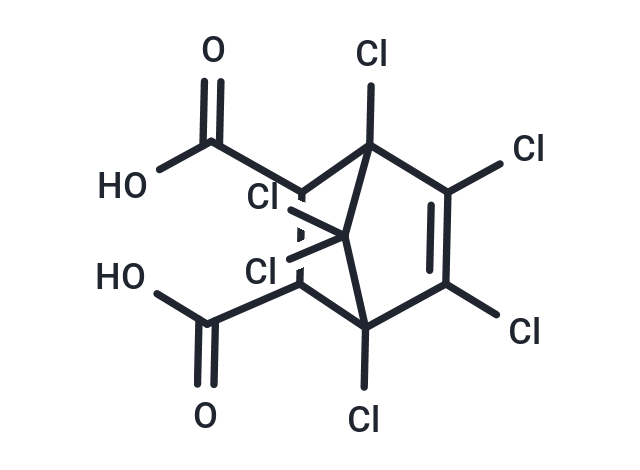
Chlorendic acid
CAS No. 115-28-6
Chlorendic acid( —— )
Catalog No. M33694 CAS No. 115-28-6
Chlorendic acid (Het acid) is a recalcitrant, highly chlorinated groundwater contaminant that is degraded by fungi and can be remediated through bioremediation.
Purity : >98% (HPLC)
 COA
Datasheet
HNMR
HPLC
MSDS
Handing Instructions
COA
Datasheet
HNMR
HPLC
MSDS
Handing Instructions
| Size | Price / USD | Stock | Quantity |
| 100MG | Get Quote | In Stock |


|
| 200MG | Get Quote | In Stock |
|
| 500MG | Get Quote | In Stock |
|
| 1G | 26 | In Stock |
|
Biological Information
-
Product NameChlorendic acid
-
NoteResearch use only, not for human use.
-
Brief DescriptionChlorendic acid (Het acid) is a recalcitrant, highly chlorinated groundwater contaminant that is degraded by fungi and can be remediated through bioremediation.
-
DescriptionChlorendic acid (Het acid) is a recalcitrant, highly chlorinated groundwater contaminant that is degraded by fungi and can be remediated through bioremediation.
-
In Vitro——
-
In Vivo——
-
Synonyms——
-
PathwayOthers
-
TargetOther Targets
-
RecptorOthers
-
Research Area——
-
Indication——
Chemical Information
-
CAS Number115-28-6
-
Formula Weight388.84
-
Molecular FormulaC9H4Cl6O4
-
Purity>98% (HPLC)
-
Solubility——
-
SMILESO=C(O)C1C(C(=O)O)C2(Cl)C(Cl)=C(Cl)C1(Cl)C2(Cl)Cl
-
Chemical Name——
Shipping & Storage Information
-
Storage(-20℃)
-
ShippingWith Ice Pack
-
Stability≥ 2 years
Reference
molnova catalog



related products
-
16-anhydro-b-D-Gluco...
16-anhydro-b-D-Glucose (Levoglucosan) is an anhydrohexose that is the 16-anhydro-derivative of beta-D-glucopyranose. It is formed from the pyrolysis of carbohydrates such as starch and cellulose. Levoglucosan can also be utilized in the synthesis of chiral polymers such as unhydrolysable glucose polymers.
-
Benzotript
Benzotript is an gastrin-receptor antagonist, with anti-gastrinic.proglumide and benzotript, a new tryptophan derivative, to inhibit acid output from isolated gastric fundic parietal cells from rabbit.
-
E-I-L-E-V-P-S-T
E-I-L-E-V-P-S-T
