


 Cart
Cart
 sales@molnova.com


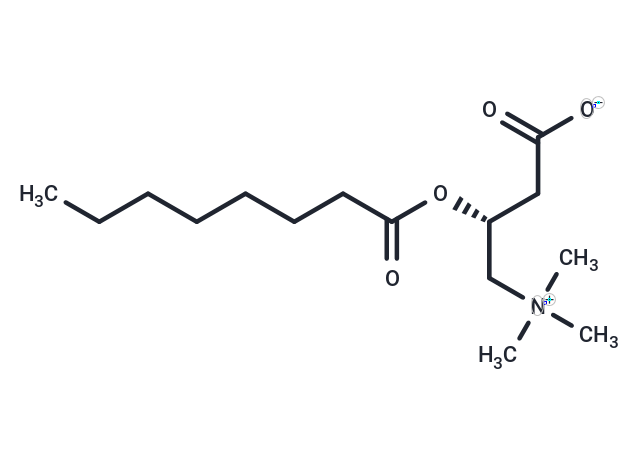
L-Octanoylcarnitine
CAS No. 25243-95-2
L-Octanoylcarnitine( —— )
Catalog No. M33608 CAS No. 25243-95-2
L-Octanoylcarnitine is the active octanoylcarnitine present in plasma and is a potential biomarker for breast cancer.
Purity : >98% (HPLC)
 COA
Datasheet
HNMR
HPLC
MSDS
Handing Instructions
COA
Datasheet
HNMR
HPLC
MSDS
Handing Instructions
| Size | Price / USD | Stock | Quantity |
| 2MG | 29 | In Stock |


|
| 5MG | 46 | In Stock |
|
| 10MG | 77 | In Stock |
|
| 25MG | 155 | In Stock |
|
| 50MG | 259 | In Stock |
|
| 100MG | 445 | In Stock |
|
| 200MG | Get Quote | In Stock |
|
| 500MG | Get Quote | In Stock |
|
| 1G | Get Quote | In Stock |
|
Biological Information
-
Product NameL-Octanoylcarnitine
-
NoteResearch use only, not for human use.
-
Brief DescriptionL-Octanoylcarnitine is the active octanoylcarnitine present in plasma and is a potential biomarker for breast cancer.
-
DescriptionL-Octanoylcarnitine is a plasma metabolite and a physiologically active form of octanoylcarnitine. L-Octanoylcarnitine can be used for the research of breast cancer.
-
In Vitro——
-
In Vivo——
-
Synonyms——
-
PathwayProteasome/Ubiquitin
-
TargetEndogenous Metabolite
-
RecptorEndogenous Metabolite
-
Research Area——
-
Indication——
Chemical Information
-
CAS Number25243-95-2
-
Formula Weight287.4
-
Molecular FormulaC15H29NO4
-
Purity>98% (HPLC)
-
SolubilityIn Vitro:?DMSO : 100 mg/mL (347.95 mM; Ultrasonic )
-
SMILESCCCCCCCC(=O)O[C@H](CC([O-])=O)C[N+](C)(C)C
-
Chemical Name——
Shipping & Storage Information
-
Storage(-20℃)
-
ShippingWith Ice Pack
-
Stability≥ 2 years
Reference
1. Kim M, et al. Association between arterial stiffness and serum L-octanoylcarnitine and lactosylceramide in overweight middle-aged subjects: 3-year follow-up study. PLoS One. 2015 Mar 17;10(3):e0119519.?
molnova catalog



related products
-
5-Methyl-2'-deoxycyt...
5-Methyl-2'-deoxycytidine is a pyrimidine nucleoside that when incorporated into single-stranded DNA can act in cis to signal de novo.
-
1-Methyladenosine
1-Methyladenosine (M1A) belongs to the class of organic compounds known as purine nucleosides.
-
Pyridoxal
Pyridoxal represents an active form of vitamin B6 .
