


 Cart
Cart
 sales@molnova.com


 Home -
Products -
Proteasome/Ubiquitin -
Endogenous Metabolite -
4-Hydroxycyclohexanecarboxylic acid
Home -
Products -
Proteasome/Ubiquitin -
Endogenous Metabolite -
4-Hydroxycyclohexanecarboxylic acid
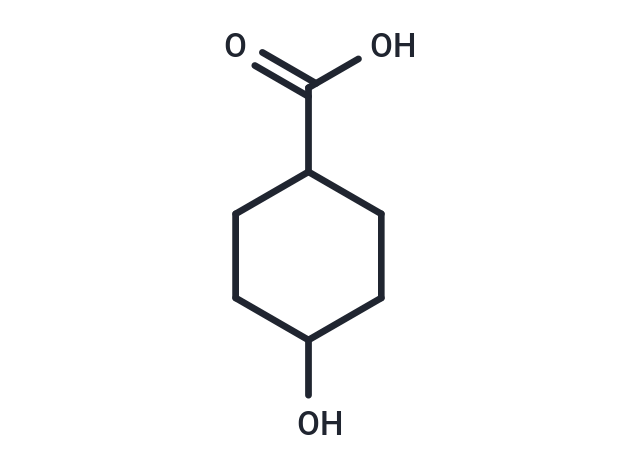
4-Hydroxycyclohexanecarboxylic acid
CAS No. 17419-81-7
4-Hydroxycyclohexanecarboxylic acid( —— )
Catalog No. M33585 CAS No. 17419-81-7
4-Hydroxycyclohexanecarboxylic acid is a substrate of cyclohexanecarboxylic acid and is isolated from olive brine.
Purity : >98% (HPLC)
 COA
Datasheet
HNMR
HPLC
MSDS
Handing Instructions
COA
Datasheet
HNMR
HPLC
MSDS
Handing Instructions
| Size | Price / USD | Stock | Quantity |
| 1 mL x 10 mM in DMSO | 28 | In Stock |


|
| 100MG | Get Quote | In Stock |
|
| 200MG | Get Quote | In Stock |
|
| 500MG | 27 | In Stock |
|
| 1G | 36 | In Stock |
|
Biological Information
-
Product Name4-Hydroxycyclohexanecarboxylic acid
-
NoteResearch use only, not for human use.
-
Brief Description4-Hydroxycyclohexanecarboxylic acid is a substrate of cyclohexanecarboxylic acid and is isolated from olive brine.
-
Description4-Hydroxycyclohexanecarboxylic acid belongs to the class of organic compounds known as cyclohexanols.
-
In Vitro——
-
In Vivo——
-
Synonyms——
-
PathwayProteasome/Ubiquitin
-
TargetEndogenous Metabolite
-
RecptorEndogenous Metabolite
-
Research Area——
-
Indication——
Chemical Information
-
CAS Number17419-81-7
-
Formula Weight144.17
-
Molecular FormulaC7H12O3
-
Purity>98% (HPLC)
-
Solubility——
-
SMILESO=C(O)C1CCC(O)CC1
-
Chemical Name——
Shipping & Storage Information
-
Storage(-20℃)
-
ShippingWith Ice Pack
-
Stability≥ 2 years
Reference
molnova catalog



related products
-
Cardiolipin (Heart, ...
Cardiolipin (Heart, Bovine) sodium is a phospholipid found in mitochondria and is involved in mitochondrial structure and function.Cardiolipin (Heart, Bovine) sodium is used in the study of neurological, cardiovascular, and metabolic diseases.
-
3-(3,4,5-Trimethoxyp...
3-(3,4,5-Trimethoxyphenyl)-propanoic acid is a constituent of Piper retrofractum and Piper longum and is found in herbs and spices.
-
2-(1-methyl-1H-imida...
2-(1-methyl-1H-imidazol-4-yl)acetic acid (2-(1-methylimidazol-4-yl)acetic acid) is a plasma histamine derivative that is a biomarker for identifying lymphangioleiomyomatosis.
