


 Cart
Cart
 sales@molnova.com


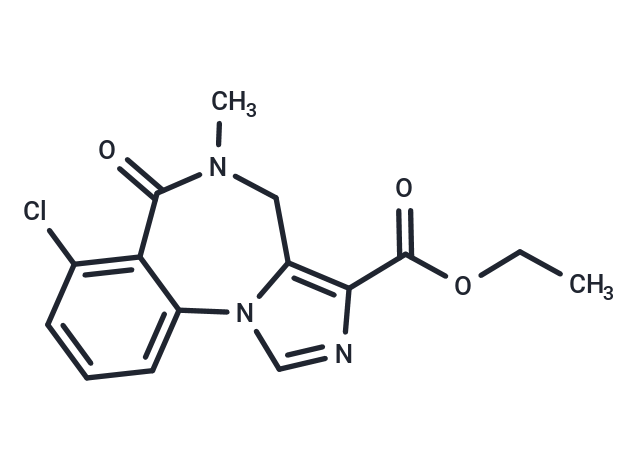
Sarmazenil
CAS No. 78771-13-8
Sarmazenil( —— )
Catalog No. M33491 CAS No. 78771-13-8
Sarmazenil (Ro 15-3505) is a partial inverse agonist at the benzodiazepine receptor with pro-convulsant properties and is used in the study of chronic hepatic encephalopathy (HE).
Purity : >98% (HPLC)
 COA
Datasheet
HNMR
HPLC
MSDS
Handing Instructions
COA
Datasheet
HNMR
HPLC
MSDS
Handing Instructions
| Size | Price / USD | Stock | Quantity |
| 5MG | 686 | In Stock |


|
| 10MG | 938 | In Stock |
|
| 25MG | 1444 | In Stock |
|
| 50MG | 1841 | In Stock |
|
| 100MG | Get Quote | In Stock |
|
| 200MG | Get Quote | In Stock |
|
| 500MG | Get Quote | In Stock |
|
| 1G | Get Quote | In Stock |
|
Biological Information
-
Product NameSarmazenil
-
NoteResearch use only, not for human use.
-
Brief DescriptionSarmazenil (Ro 15-3505) is a partial inverse agonist at the benzodiazepine receptor with pro-convulsant properties and is used in the study of chronic hepatic encephalopathy (HE).
-
DescriptionSarmazenil is a benzodiazepine receptor antagonist.
-
In Vitro——
-
In Vivo——
-
Synonyms——
-
PathwayOthers
-
TargetOther Targets
-
RecptorGABA Receptor
-
Research Area——
-
Indication——
Chemical Information
-
CAS Number78771-13-8
-
Formula Weight319.74
-
Molecular FormulaC15H14ClN3O3
-
Purity>98% (HPLC)
-
Solubility——
-
SMILESO=C(OCC)C=1N=CN2C=3C=CC=C(Cl)C3C(=O)N(C)CC12
-
Chemical Name——
Shipping & Storage Information
-
Storage(-20℃)
-
ShippingWith Ice Pack
-
Stability≥ 2 years
Reference
1. Gath I, et al. Electrophysiological aspects of benzodiazepine antagonists, Ro 15-1788 and Ro 15-3505. Br J Clin Pharmacol. 1984 Oct;18(4):541-7.?
molnova catalog



related products
-
Menthyl isovalerate
Menthyl isovalerate is a bioactive chemical.
-
Scutellarein 7-O-dig...
Scutellarein 7-O-diglucuronide
-
AEOL-10150 pentachlo...
AEOL-10150 pentachloride is a metalloporphyrin catalytic antioxidant. AEOL-10150 pentachloride also is a superoxide dismutase mimetic. Which protects lungs from radiation-induced injury.
