


 Cart
Cart
 sales@molnova.com


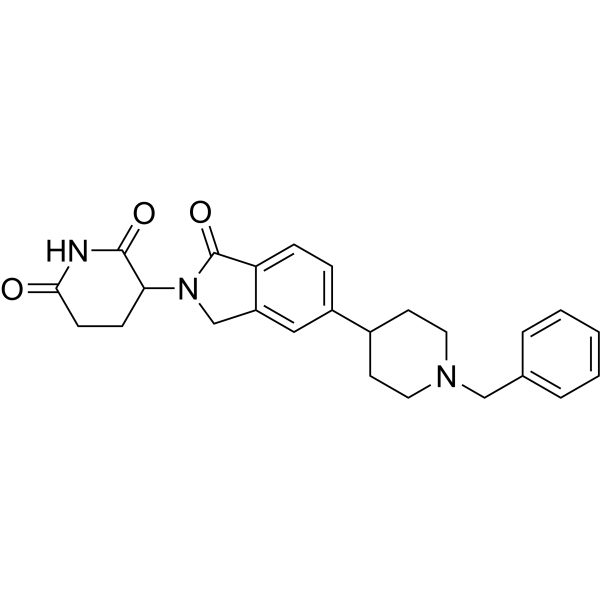
NVP-DKY709
CAS No. 2291360-73-9
NVP-DKY709( —— )
Catalog No. M28913 CAS No. 2291360-73-9
NVP-DKY709 is a potent IKZF2 inhibitor for the treatment of cancers.
Purity : >98% (HPLC)
 COA
Datasheet
HNMR
HPLC
MSDS
Handing Instructions
COA
Datasheet
HNMR
HPLC
MSDS
Handing Instructions
| Size | Price / USD | Stock | Quantity |
| 1 mL x 10 mM in DMSO | 254 | In Stock |


|
| 5MG | 231 | In Stock |
|
| 10MG | 370 | In Stock |
|
| 25MG | 605 | In Stock |
|
| 50MG | 732 | In Stock |
|
| 100MG | 918 | In Stock |
|
| 200MG | Get Quote | In Stock |
|
| 500MG | 1841 | In Stock |
|
| 1G | Get Quote | In Stock |
|
Biological Information
-
Product NameNVP-DKY709
-
NoteResearch use only, not for human use.
-
Brief DescriptionNVP-DKY709 is a potent IKZF2 inhibitor for the treatment of cancers.
-
DescriptionNVP-DKY709 is a potent IKZF2 inhibitor for the treatment of cancers.
-
In Vitro——
-
In Vivo——
-
Synonyms——
-
PathwayOthers
-
TargetOther Targets
-
RecptorApelin receptor
-
Research Area——
-
Indication——
Chemical Information
-
CAS Number2291360-73-9
-
Formula Weight417.5
-
Molecular FormulaC25H27N3O3
-
Purity>98% (HPLC)
-
SolubilityIn Vitro:?DMSO : 16.67 mg/mL (39.93 mM)
-
SMILES——
-
Chemical Name——
Shipping & Storage Information
-
Storage(-20℃)
-
ShippingWith Ice Pack
-
Stability≥ 2 years
Reference
1.Trifonov L, et al. An Expedient Synthesis of CMF-019: (S)-5-Methyl-3-{1-(pentan-3-yl)-2- (thiophen-2-ylmethyl)-1H-benzo[d]imidazole-5-carboxamido}hexanoic Acid, a Potent Apelin Receptor (APJ) Agonist. Med Chem. 2018;14(7):688-694.
molnova catalog



related products
-
3-Hydroxytectorigeni...
3′-Hydroxytectorigenin-7-O-β-D-xylosyl-(1→6)-β-D-glucopyranoside is an antioxidant that can be found in Pueraria montana var. lobata. It exhibits DPPH radical scavenging activity, with an IC50 value of 42 μg/mL.
-
6-Hydroxykaempferol-...
6-hydroxykaempferol 3,6,7-tri-O-β-D-glucoside is a bio-active flavonoid from Carthamus tinctorius with antioxidant capacities in vitro.
-
5-A-RU hydrochloride
5-A-RU hydrochloride (5-Amino-6-(D-ribitylamino)uracil hydrochloride) is an intermediate of bacterial riboflavin that activates mucosal-associated invariant T cells (MAIT).
