


 Cart
Cart
 sales@molnova.com


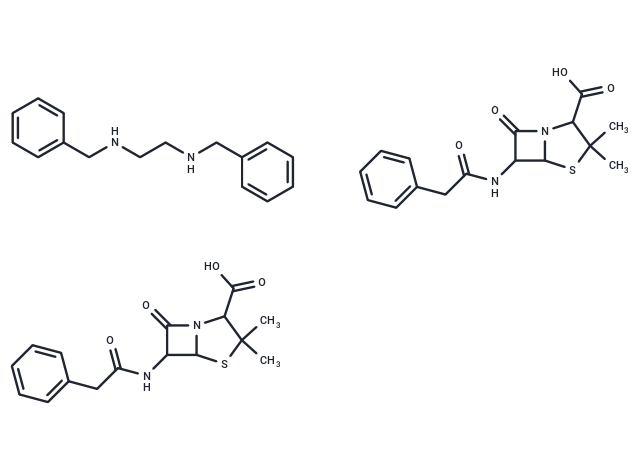
Penicillin G benzathine
CAS No. 1538-09-6
Penicillin G benzathine( —— )
Catalog No. M33459 CAS No. 1538-09-6
Penicillin G benzathine has anti-bacterial infectious activity and can be used to study early syphilis.
Purity : >98% (HPLC)
 COA
Datasheet
HNMR
HPLC
MSDS
Handing Instructions
COA
Datasheet
HNMR
HPLC
MSDS
Handing Instructions
| Size | Price / USD | Stock | Quantity |
| 25MG | 34 | In Stock |


|
| 50MG | 47 | In Stock |
|
| 100MG | 83 | In Stock |
|
| 200MG | Get Quote | In Stock |
|
| 500MG | 204 | In Stock |
|
| 1G | Get Quote | In Stock |
|
Biological Information
-
Product NamePenicillin G benzathine
-
NoteResearch use only, not for human use.
-
Brief DescriptionPenicillin G benzathine has anti-bacterial infectious activity and can be used to study early syphilis.
-
DescriptionPenicillin G benzathine (Benzathine benzylpenicillin) is an antibiotic against many bacterial infections.
-
In Vitro——
-
In VivoPenicillin G benzathine displays activity and antibacterial effect in CD-I mice infected with Staphylococcus aureus Smith.
-
Synonyms——
-
PathwayGPCR/G Protein
-
TargetAntibacterial
-
RecptorAntibacterial
-
Research Area——
-
Indication——
Chemical Information
-
CAS Number1538-09-6
-
Formula Weight909.13
-
Molecular FormulaC48H56N6O8S2
-
Purity>98% (HPLC)
-
Solubility——
-
SMILESC(CNCc1ccccc1)NCc1ccccc1.CC1(C)SC2C(NC(=O)Cc3ccccc3)C(=O)N2C1C(O)=O.CC1(C)SC2C(NC(=O)Cc3ccccc3)C(=O)N2C1C(O)=O
-
Chemical Name——
Shipping & Storage Information
-
Storage(-20℃)
-
ShippingWith Ice Pack
-
Stability≥ 2 years
Reference
1. Bowen AC, et al. Short-course oral co-trimoxazole versus intramuscular benzathine benzylpenicillin for impetigo in a highly endemic region: an open-label, randomised, controlled, non-inferiority trial. Lancet. 2014 Dec 13;384(9960):2132-40.?
molnova catalog



related products
-
Meropenem trihydrate
Meropenem trihydrate with broad-spectrum antibacterial activity,is a carbapenem antibiotic.
-
VB-82252
VB-82252 is a highly potent, orally active inhibitor of C. difficile toxins TcdA and TcdB, potently inhibits UDP glucose hydrolysis activity of TcdB (IC50=32 nM).
-
Sulfisoxazole acetyl
Sulfisoxazole acetyl is an agent with antibacterial activity. Sulfisoxazole acetyl is a Sulfisoxazole derivative with antibacterial activity. Sulfisoxazole acetyl is an inhibitor of dihydropteroate synthase.
