


 Cart
 sales@molnova.com


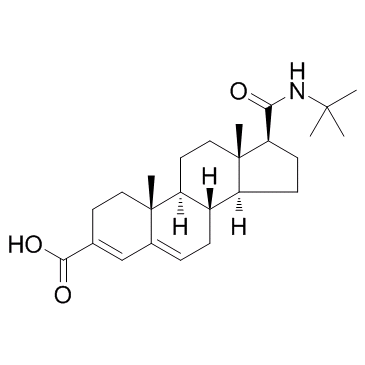
Epristeride
CAS No. 119169-78-7
Epristeride( —— )
Catalog No. M33351 CAS No. 119169-78-7
Epristeride (ONO-9302) is an orally active, selective and non-competitive steroidal 5-α-reductase isoform 2 inhibitor that inhibits SR isoform 2.
Purity : >98% (HPLC)
 COA
Datasheet
HNMR
HPLC
MSDS
Handing Instructions
| Size | Price / USD | Stock | Quantity |
| 1 mL x 10 mM in DMSO | 258 | In Stock |


|
| 2MG | 140 | In Stock |
|
| 5MG | 235 | In Stock |
|
| 10MG | 376 | In Stock |
|
| 25MG | 755 | In Stock |
|
| 100MG | Get Quote | In Stock |
|
| 200MG | Get Quote | In Stock |
|
| 500MG | Get Quote | In Stock |
|
| 1G | Get Quote | In Stock |
|
Biological Information
-
Product NameEpristeride
-
NoteResearch use only, not for human use.
-
Brief DescriptionEpristeride (ONO-9302) is an orally active, selective and non-competitive steroidal 5-α-reductase isoform 2 inhibitor that inhibits SR isoform 2.
-
DescriptionEpristeride (ONO-9302) is a selective, specific and orally active uncompetitive inhibitor of human steroid 5 alpha-reductase isoform 2. Epristeride has inhibitory effects for SR isoenzymes types 2 with Ki value of 0.7-2 nM. Epristeride can be used for the research of prostatic hyperplasia and acne.
-
In VitroEpristeride has inhibitory effects for SR isoenzymes types 2 (SR2) with Ki values of 0.7-2 nM.
-
In Vivo——
-
Synonyms——
-
PathwayApoptosis
-
TargetApoptosis
-
RecptorApoptosis | Reductase
-
Research Area——
-
Indication——
Chemical Information
-
CAS Number119169-78-7
-
Formula Weight399.57
-
Molecular FormulaC25H37NO3
-
Purity>98% (HPLC)
-
SolubilityIn Vitro:?DMSO : 100 mg/mL (250.27 mM; Ultrasonic )
-
SMILES[H][C@@]12CC[C@H](C(=O)NC(C)(C)C)[C@@]1(C)CC[C@@]1([H])[C@@]2([H])CC=C2C=C(CC[C@]12C)C(O)=O
-
Chemical Name——
Shipping & Storage Information
-
Storage(-20℃)
-
ShippingWith Ice Pack
-
Stability≥ 2 years
Reference



-
Exisulind
Exisulind induces apoptosis through the activation of protein kinase G (PKG). Exisulind exhibits antineoplastic activity in solid tumour and haematological cancer cell lines and is an inhibitor of tumour growth in rodent models of colon, prostate, bladder, mammary and lung cancer.
-
Oxypalmatine
Oxypalmatine (8-Oxypalmatine) is a berberine-type alkaloid isolated from Phellodendron amurense that regulates breast cancer cell proliferation and apoptosis by inhibiting PI3K/AKT signaling and its efficacy in breast cancer-like organs.
-
Bifenthrin
Bifenthrin is a synthetic pyrethroid insecticide.Bifenthrin induces cell death in bovine mammary epithelial cells through ROS generation, disruption of calcium homeostasis, and alteration of the MAPK signaling cascade.Bifenthrin induces apoptosis by inducing cell-cycle arrest.
