


 Cart
Cart
 sales@molnova.com


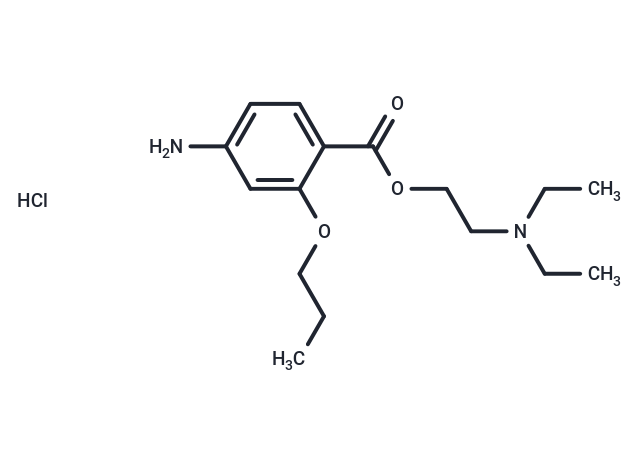
Propoxycaine hydrochloride
CAS No. 550-83-4
Propoxycaine hydrochloride( —— )
Catalog No. M33229 CAS No. 550-83-4
Propoxycaine hydrochloride, an ester local anesthetic, inhibits voltage-gated sodium channels, modulates nerve impulses, and can induce sensory loss.
Purity : >98% (HPLC)
 COA
Datasheet
HNMR
HPLC
MSDS
Handing Instructions
COA
Datasheet
HNMR
HPLC
MSDS
Handing Instructions
| Size | Price / USD | Stock | Quantity |
| 1 mL x 10 mM in DMSO | 42 | In Stock |


|
| 5MG | 38 | In Stock |
|
| 10MG | 57 | In Stock |
|
| 25MG | 75 | In Stock |
|
| 100MG | Get Quote | In Stock |
|
| 200MG | Get Quote | In Stock |
|
| 500MG | Get Quote | In Stock |
|
| 1G | Get Quote | In Stock |
|
Biological Information
-
Product NamePropoxycaine hydrochloride
-
NoteResearch use only, not for human use.
-
Brief DescriptionPropoxycaine hydrochloride, an ester local anesthetic, inhibits voltage-gated sodium channels, modulates nerve impulses, and can induce sensory loss.
-
DescriptionPropoxycaine hydrochloride inhibits voltage-gated sodium channels, and thereby inhibits the ionic flux required for the initiation and conduction of impulses. Propoxycaine hydrochloride application can lead to a loss of sensation.
-
In Vitro——
-
In Vivo——
-
Synonyms——
-
PathwayMembrane Transporter/Ion Channel
-
TargetSodium Channel
-
RecptorSodium Channel
-
Research Area——
-
Indication——
Chemical Information
-
CAS Number550-83-4
-
Formula Weight330.85
-
Molecular FormulaC16H27ClN2O3
-
Purity>98% (HPLC)
-
SolubilityIn Vitro:?H2O : 100 mg/mL (302.25 mM; Ultrasonic) DMSO : 50 mg/mL (151.13 mM; Ultrasonic )
-
SMILESCl.CCCOc1cc(N)ccc1C(=O)OCCN(CC)CC
-
Chemical Name——
Shipping & Storage Information
-
Storage(-20℃)
-
ShippingWith Ice Pack
-
Stability≥ 2 years
Reference
molnova catalog



related products
-
VGSCs-IN-1
VGSCs-IN-1 is a potent VGSC inhibitor, a 2-piperazine analog of Riluzole that exhibits good blocking activity on Nav1.4.VGSCs-IN-1 can be used to study cellular excitability disorders.
-
E 0747
E 0747 (E0747) is a new antiarrhythmic compound that inhibits arrhythmias by inhibiting Na channels in cardiac cells.
-
Allocryptopine
Allocryptopine induces muscle contraction and relaxation in urinary bladder and ileum, respectively.
