


 Cart
Cart
 sales@molnova.com


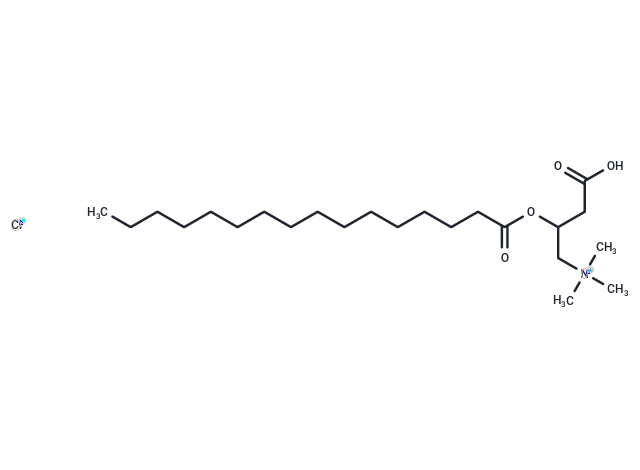
Palmitoylcarnitine chloride
CAS No. 6865-14-1
Palmitoylcarnitine chloride( —— )
Catalog No. M33228 CAS No. 6865-14-1
Palmitoylcarnitine chloride (Palmitoyl DL-carnitine chloride) is a mitochondrial fatty acid oxidation intermediate that mediates intralipid cardioprotection.
Purity : >98% (HPLC)
 COA
Datasheet
HNMR
HPLC
MSDS
Handing Instructions
COA
Datasheet
HNMR
HPLC
MSDS
Handing Instructions
| Size | Price / USD | Stock | Quantity |
| 1 mL x 10 mM in DMSO | 28 | In Stock |


|
| 25MG | 42 | In Stock |
|
| 50MG | 56 | In Stock |
|
| 100MG | Get Quote | In Stock |
|
| 200MG | Get Quote | In Stock |
|
| 500MG | Get Quote | In Stock |
|
| 1G | Get Quote | In Stock |
|
Biological Information
-
Product NamePalmitoylcarnitine chloride
-
NoteResearch use only, not for human use.
-
Brief DescriptionPalmitoylcarnitine chloride (Palmitoyl DL-carnitine chloride) is a mitochondrial fatty acid oxidation intermediate that mediates intralipid cardioprotection.
-
DescriptionPalmitoylcarnitine chloride is a fatty acid-derived mitochondrial substrate, and selectively decreases cell survival in colorectal and prostate cancer cells by affecting on pro-inflammatory pathways, Ca2+ influx, and DHT-like effects.
-
In Vitro——
-
In Vivo——
-
Synonyms——
-
PathwayAngiogenesis
-
TargetPKC
-
RecptorPKC
-
Research Area——
-
Indication——
Chemical Information
-
CAS Number6865-14-1
-
Formula Weight436.07
-
Molecular FormulaC23H46ClNO4
-
Purity>98% (HPLC)
-
SolubilityIn Vitro:?H2O : 50 mg/mL (114.66 mM; Ultrasonic)
-
SMILES[Cl-].CCCCCCCCCCCCCCCC(=O)OC(CC(O)=O)C[N+](C)(C)C
-
Chemical Name——
Shipping & Storage Information
-
Storage(-20℃)
-
ShippingWith Ice Pack
-
Stability≥ 2 years
Reference
1. Al-Bakheit A, et al. Accumulation of Palmitoylcarnitine and Its Effect on Pro-Inflammatory Pathways and Calcium Influx in Prostate Cancer. Prostate. 2016 Oct;76(14):1326-37.?
molnova catalog



related products
-
Valrubicin
Valrubicin (AD 32) inhibits TPA- and PDBu-induced PKC activation (IC50s: 0.85 and 1.25 μM) and has antitumor and anti-inflammatory activity.
-
LY379196
LY379196 is a highly specific PKCβ inhibitor with IC50 of 30-50 nM for PKCβI and PKCβII.
-
PKC-theta inhibitor ...
PKC-theta inhibitor is a selective PKC-θinhibitor(IC50:12 nM).
