


 Cart
Cart
 sales@molnova.com


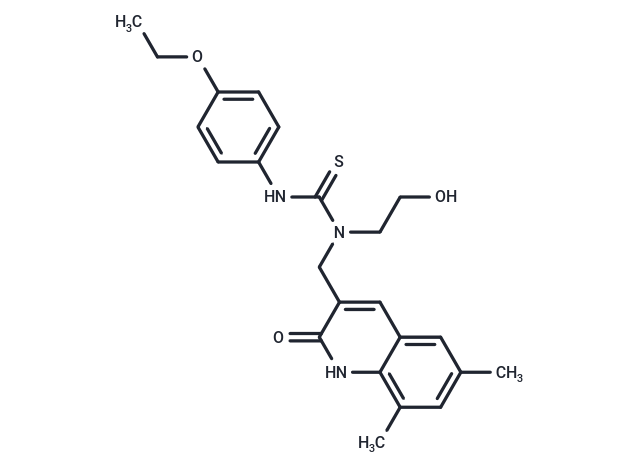
β-Glucuronidase-IN-1
CAS No. 484006-66-8
β-Glucuronidase-IN-1( —— )
Catalog No. M33191 CAS No. 484006-66-8
β-Glucuronidase-IN-1 is an E. coli β-glucuronidase (β-glucuronidase) inhibitor with a potent, selective, non-competitive, and orally active IC50 and Ki value of 283 nM and 164 nM, respectively, against E. coli β-glucuronidase.
Purity : >98% (HPLC)
 COA
Datasheet
HNMR
HPLC
MSDS
Handing Instructions
COA
Datasheet
HNMR
HPLC
MSDS
Handing Instructions
| Size | Price / USD | Stock | Quantity |
| 1 mL x 10 mM in DMSO | 93 | In Stock |


|
| 5MG | 85 | In Stock |
|
| 10MG | 132 | In Stock |
|
| 25MG | 221 | In Stock |
|
| 50MG | 323 | In Stock |
|
| 100MG | 480 | In Stock |
|
| 200MG | Get Quote | In Stock |
|
| 500MG | 1014 | In Stock |
|
| 1G | Get Quote | In Stock |
|
Biological Information
-
Product Nameβ-Glucuronidase-IN-1
-
NoteResearch use only, not for human use.
-
Brief Descriptionβ-Glucuronidase-IN-1 is an E. coli β-glucuronidase (β-glucuronidase) inhibitor with a potent, selective, non-competitive, and orally active IC50 and Ki value of 283 nM and 164 nM, respectively, against E. coli β-glucuronidase.
-
Descriptionβ-Glucuronidase-IN-1 is a potent, selective, uncompetitive, and orally active E. coli bacterial β-glucuronidase inhibitor, exhibitingan IC50 and a Ki of 283 nM and 164 nM, respectively.
-
In Vitroβ-Glucuronidase-IN-1 (Inhibitor 1) (0.01-100 μM) inhibits E. coli?β-glucuronidase activity as a dose-dependent manner and exhibits an IC50 and a Ki value with 283 nM and 164 nM, respectively.β-Glucuronidase-IN-1 (100 μM; 24-72 hours) maintains potent efficacy in living bacterial cells (EC50=17.7 nM), it does not affect bacterial cell growth under aerobic or anaerobic conditions or killing mammalian epithelial cells. Cell Viability AssayCell Line:CMT93, CaCO-2, HCT116 cells Concentration:100 μM Incubation Time:24hours, 48 hours and 72 hours Result:Did not impact mammalian cell survival and any reduction in cell viability were attributed to the presence of DMSO.
-
In Vivoβ-Glucuronidase-IN-1 (oral gavage; 10 μg; twice per day; 11 days) protects the mouse GI epithelium from CPT-11–induced damage and protects the glandular structure of CPT-11-treated intestinal tissues.Animal Model:Healthy 6- to 8-week-old Balb/cJ mice Dosage:10 μg Administration:Oral gavage; twice per day; 11 daysResult:Alleviated CPT-11-induced toxicity in mice.
-
Synonyms——
-
PathwayGPCR/G Protein
-
TargetAntibacterial
-
RecptorAntibacterial
-
Research Area——
-
Indication——
Chemical Information
-
CAS Number484006-66-8
-
Formula Weight425.54
-
Molecular FormulaC23H27N3O3S
-
Purity>98% (HPLC)
-
SolubilityIn Vitro:?DMSO : 100 mg/mL (235.00 mM; Ultrasonic (<60°C)
-
SMILESCCOc1ccc(NC(=S)N(CCO)Cc2cc3cc(C)cc(C)c3[nH]c2=O)cc1
-
Chemical Name——
Shipping & Storage Information
-
Storage(-20℃)
-
ShippingWith Ice Pack
-
Stability≥ 2 years
Reference
1. Wallace BD, et al. Alleviating cancer drug toxicity by inhibiting a bacterial enzyme.Science.?2010 Nov 5;330(6005):831-5.?
molnova catalog



related products
-
Sutezolid
An oxazolidinone antibiotic that possesses potent antituberculosis activity in vitro and in vivo.
-
Gatifloxacin mesylat...
A fourth-generation fluoroquinolone antibiotic that inhibits the bacterial DNA gyrase and topoisomerase IV.
-
Methylisothiazolinon...
Methylisothiazolinone is a powerful synthetic biocide and preservative within the group of isothiazolinones.
