


 Cart
Cart
 sales@molnova.com


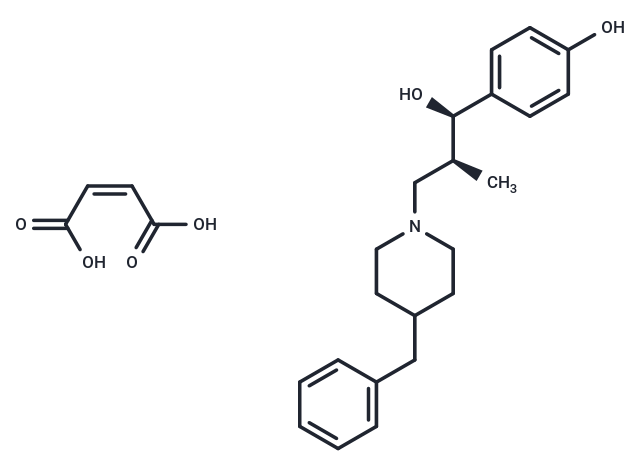
Ro 25-6981 Maleate
CAS No. 1312991-76-6
Ro 25-6981 Maleate( —— )
Catalog No. M33109 CAS No. 1312991-76-6
Ro 25-6981 Maleate is a potent and selective activity-dependent NMDA receptor blocker, specifically targeting the NR2B subunit (IC50 values are 0.009 μM for NR1C/NR2B and 52 μM for NR1C/NR2A receptor subunit combinations).
Purity : >98% (HPLC)
 COA
Datasheet
HNMR
HPLC
MSDS
Handing Instructions
COA
Datasheet
HNMR
HPLC
MSDS
Handing Instructions
| Size | Price / USD | Stock | Quantity |
| 1 mL x 10 mM in DMSO | 82 | In Stock |


|
| 5MG | 74 | In Stock |
|
| 10MG | 107 | In Stock |
|
| 25MG | 218 | In Stock |
|
| 50MG | 368 | In Stock |
|
| 100MG | 693 | In Stock |
|
| 200MG | Get Quote | In Stock |
|
| 500MG | Get Quote | In Stock |
|
| 1G | Get Quote | In Stock |
|
Biological Information
-
Product NameRo 25-6981 Maleate
-
NoteResearch use only, not for human use.
-
Brief DescriptionRo 25-6981 Maleate is a potent and selective activity-dependent NMDA receptor blocker, specifically targeting the NR2B subunit (IC50 values are 0.009 μM for NR1C/NR2B and 52 μM for NR1C/NR2A receptor subunit combinations).
-
DescriptionRo 25-6981 Maleate is a potent, selective and activity-dependent NR2B subunit specific NMDA receptor antagonist. Ro 25-6981 Maleat shows anticonvulsant and anti-parkinsonian activity. Ro 25-6981 Maleate has the potential for the research of parkinson's disease (PD).
-
In Vitro——
-
In VivoRo 25-6981 Maleate (0.39-12.5 mg/kg; i.p.) induces contraversive rotations in 6-hydroxydopamine (6-OHDA)-lesioned rats without stimulating locomotion in normal rats.Ro 25-6981 Maleate (1,3 mg/kg; i.p.) exhibits age- and activation-dependent anticonvulsant action at early postnatal development in rats.Ro 25-6981 Maleate (800 μg; intrathecal injection) shows significant analgesic effects on incision pain in rats and effectively attenuated postoperative hyperalgesia induced by remifentanil. Animal Model:6-OHDA-lesioned rats Dosage:0.39-12.5 mg/kg Administration:I.p.Result:Dose-dependently induced contraversive tight nose-to-tail rotations, and induced a weak ipsiversive circling response indicating a mild unspecific stimulatory action of the compound.Animal Model: Male albino rats of Wistar strain Dosage:1, 3 mg/kg Administration: I.p.Result: Caused a significant decrease of N1–P2 amplitude at higher stimulation intensities AT 3 mg/kg, and exhibited age- and activation-dependent anticonvulsant action at early postnatal development.
-
Synonyms——
-
PathwayMembrane Transporter/Ion Channel
-
TargetNMDAR
-
RecptorNMDAR
-
Research Area——
-
Indication——
Chemical Information
-
CAS Number1312991-76-6
-
Formula Weight455.54
-
Molecular FormulaC26H33NO6
-
Purity>98% (HPLC)
-
SolubilityIn Vitro:?DMSO : 100 mg/mL (219.52 mM; Ultrasonic ) H2O : 8.33 mg/mL (18.29 mM; ultrasonic and warming and heat to 45°C)
-
SMILESOC(=O)\C=C/C(O)=O.C[C@@H](CN1CCC(Cc2ccccc2)CC1)[C@@H](O)c1ccc(O)cc1
-
Chemical Name——
Shipping & Storage Information
-
Storage(-20℃)
-
ShippingWith Ice Pack
-
Stability≥ 2 years
Reference
1. L?schmann PA, et al. Antiparkinsonian activity of Ro 25-6981, a NR2B subunit specific NMDA receptor antagonist, in animal models of Parkinson's disease. Exp Neurol. 2004 May;187(1):86-93.?
molnova catalog



related products
-
Macranthoidin B
Macranthoidin B, a saponin extracted from Flos Lonicerae is a main bioactive saponin in rat plasma (p.o.).
-
Dextrorphan (tartrat...
Dextrophan tartrate is a glutamate receptor antagonist potentially for the treatment of stroke.
-
Ro 8-4304 Hydrochlor...
Ro 8-4304 Hydrochloride is an antagonist of NMDA receptor with IC50 of 0.4 μM?Ro 8-4304 is a voltage-independent, non-competitive antagonist of NMDA receptors in rat cultured cortical neurones and exhibits a state-dependent mode of action similar to that described for ifenprodil.
