


 Cart
Cart
 sales@molnova.com


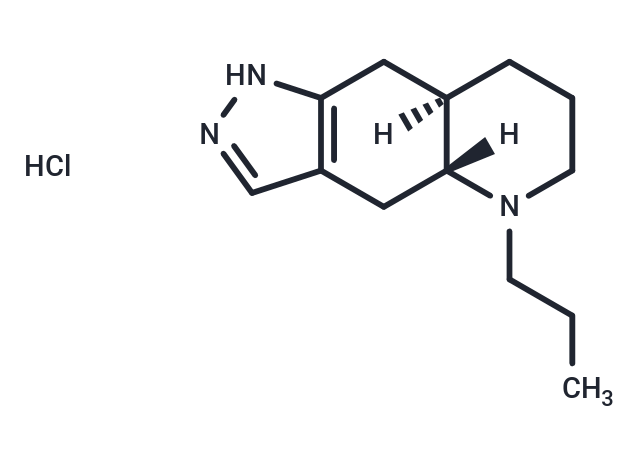
Quinpirole Hydrochloride
CAS No. 85798-08-9
Quinpirole Hydrochloride( —— )
Catalog No. M33087 CAS No. 85798-08-9
Quinpirole Hydrochloride (LY 171555), as an agonist with high affinity for dopamine receptor D2/D3, has been widely used to study the function of dopamine receptor D2/D3 in humans and mice
Purity : >98% (HPLC)
 COA
Datasheet
HNMR
HPLC
MSDS
Handing Instructions
COA
Datasheet
HNMR
HPLC
MSDS
Handing Instructions
| Size | Price / USD | Stock | Quantity |
| 2MG | 150 | In Stock |


|
| 100MG | Get Quote | In Stock |
|
| 200MG | Get Quote | In Stock |
|
| 500MG | Get Quote | In Stock |
|
| 1G | Get Quote | In Stock |
|
Biological Information
-
Product NameQuinpirole Hydrochloride
-
NoteResearch use only, not for human use.
-
Brief DescriptionQuinpirole Hydrochloride (LY 171555), as an agonist with high affinity for dopamine receptor D2/D3, has been widely used to study the function of dopamine receptor D2/D3 in humans and mice
-
DescriptionQuinpirole Hydrochloride ((-)-LY 171555) is a high-affinity agonist of dopamine D2/D3 receptor.
-
In Vitro——
-
In VivoDA content is left brain biased across groups, and although this asymmetry appears greater in saline controls than all drug-treated groups, there is not a significant interaction between Side and Group. When each side is considered separately it can be seen that in the left brain structure, DA levels progressively decrease with chronic quinpirole treatment, with the QQ rats differing significantly from saline controls. In contrast, right cortical DA levels are only altered significantly (increased) by acute Quinpirole. It can be found that DOPAC levels are also left brain biased across groups. However, no significant Group or interaction effects are found. Rats receiving acute Quinpirole show a selective increase in DA content and decrease in turnover ratio, relative to either saline controls or the QS group. Sensitized (QQ) rats however, have elevated DOPAC levels in comparison to the acute quinpirole group. In striatum as well, all three measures of DA function differed significantly across groups (DA, F3,33=6.27, P=0.0020; DOPAC, F3,33=7.98, P=0.0004; turnover ratio, F3,33=16.85, P<0.0001). In the acute quinpirole rats, both DOPAC and turnover ratio are significantly reduced relative to all other groups. In QQ rats, DOPAC levels are significantly greater than all other groups, while for turnover ratio, both chronic quinpirole groups were increased compared to both chronic saline groups.
-
Synonyms——
-
PathwayGPCR/G Protein
-
TargetDopamine Receptor
-
RecptorDopamine Receptor
-
Research Area——
-
Indication——
Chemical Information
-
CAS Number85798-08-9
-
Formula Weight255.79
-
Molecular FormulaC13H22ClN3
-
Purity>98% (HPLC)
-
SolubilityIn Vitro:?H2O : 50 mg/mL (195.47 mM; Ultrasonic) DMSO : 27.78 mg/mL (108.60 mM; Ultrasonic )
-
SMILESCl.[H][C@]12CCCN(CCC)[C@]1([H])Cc1cn[nH]c1C2
-
Chemical Name——
Shipping & Storage Information
-
Storage(-20℃)
-
ShippingWith Ice Pack
-
Stability≥ 2 years
Reference
1. Sullivan RM, et al. Effects of quinpirole on central dopamine systems in sensitized and non-sensitized rats. Neuroscience. 1998 Apr;83(3):781-9.?
molnova catalog



related products
-
Pridopidine
Pridopidine (ACR16, FR-310826, ASP-2314, Huntexil) is a specific dopamine stabilizer without no partial agonism.
-
AHN 1-055 hydrochlor...
AHN 1-055 hydrochloride is an inhibitor of dopamine transporter (DAT) and dopamine uptake(IC50 = 71 nM).
-
Levosulpiride
Levosulpiride is the (S)-enantiomer of sulpiride, which is a D2 receptor a antagonist, an atypical antipsychotic drug of the benzamide class.
