


 Cart
 sales@molnova.com


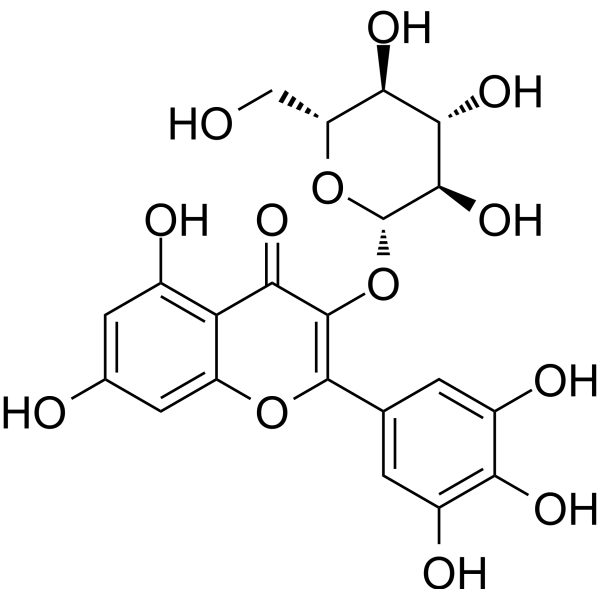
Myricetin 3-O-beta-D-glucopyranoside
CAS No. 19833-12-6
Myricetin 3-O-beta-D-glucopyranoside( —— )
Catalog No. M31691 CAS No. 19833-12-6
Myricetin 3-O-glucoside is a flavonol extracted from Tibouchina paratropica.
Purity : >98% (HPLC)
 COA
Datasheet
HNMR
HPLC
MSDS
Handing Instructions
| Size | Price / USD | Stock | Quantity |
| 5MG | 278 | In Stock |


|
| 10MG | 406 | In Stock |
|
| 25MG | 621 | In Stock |
|
| 100MG | Get Quote | In Stock |
|
| 200MG | Get Quote | In Stock |
|
| 500MG | Get Quote | In Stock |
|
| 1G | Get Quote | In Stock |
|
Biological Information
-
Product NameMyricetin 3-O-beta-D-glucopyranoside
-
NoteResearch use only, not for human use.
-
Brief DescriptionMyricetin 3-O-glucoside is a flavonol extracted from Tibouchina paratropica.
-
DescriptionMyricetin 3-O-glucoside is a flavonol extracted from Tibouchina paratropica. Myricetin 3-O-glucoside has many activities, including anti-leishmania, anti-inflammatory and antibacterial activities.
-
In Vitro——
-
In Vivo——
-
Synonyms——
-
PathwayOthers
-
TargetOther Targets
-
Recptor——
-
Research Area——
-
Indication——
Chemical Information
-
CAS Number19833-12-6
-
Formula Weight480.4
-
Molecular FormulaC21H20O13
-
Purity>98% (HPLC)
-
Solubility——
-
SMILES——
-
Chemical Name——
Shipping & Storage Information
-
Storage(-20℃)
-
ShippingWith Ice Pack
-
Stability≥ 2 years
Reference
molnova catalog



related products
-
Hydroxy-ε-sanshool
Hydroxy-Epsilon-Sanshool is an alkylamide isolated from Zanthoxylum bungeanum. Hydroxy-Epsilon-Sanshool produces key tingling and numbing chemosensates, and its content is important in determinant the pungency intensity of Zanthoxylum bungeanum.
-
Alpha-Angelica Lacto...
Alpha-Angelica Lactone has cardiotonic activity may exert their effects by providing an increased contraction-dependent calcium pool to be released upon systolic depolarization.?
-
Isogambogic acid
Isogambogic acid shows cytotoxic activiity against KB and drug-resistant KB-V1 cell lines.
