


 Cart
Cart
 sales@molnova.com


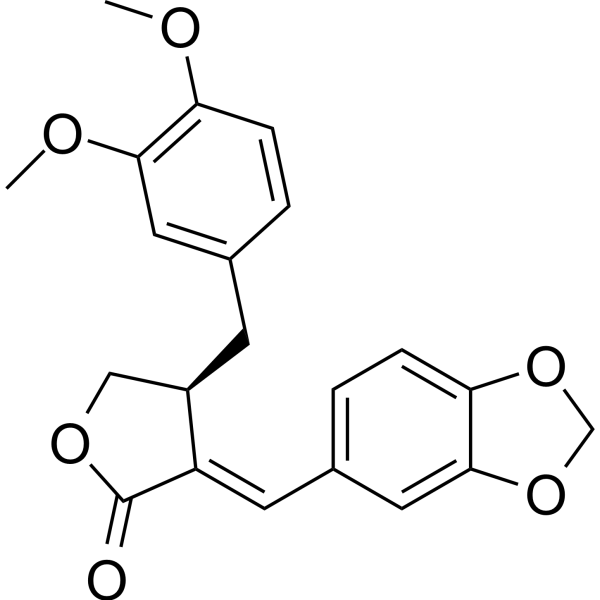
Suchilactone
CAS No. 50816-74-5
Suchilactone( —— )
Catalog No. M31506 CAS No. 50816-74-5
Suchilactone may have the potential to be developed as a treatment of Alzheimer's Disease.
Purity : >98% (HPLC)
 COA
Datasheet
HNMR
HPLC
MSDS
Handing Instructions
COA
Datasheet
HNMR
HPLC
MSDS
Handing Instructions
| Size | Price / USD | Stock | Quantity |
| 5MG | 486 | In Stock |


|
| 50MG | Get Quote | In Stock |
|
| 100MG | Get Quote | In Stock |
|
| 200MG | Get Quote | In Stock |
|
| 500MG | Get Quote | In Stock |
|
| 1G | Get Quote | In Stock |
|
Biological Information
-
Product NameSuchilactone
-
NoteResearch use only, not for human use.
-
Brief DescriptionSuchilactone may have the potential to be developed as a treatment of Alzheimer's Disease.
-
DescriptionSuchilactone may have the potential to be developed as a treatment of Alzheimer's Disease.
-
In Vitro——
-
In Vivo——
-
Synonyms——
-
PathwayOthers
-
TargetOther Targets
-
Recptor——
-
Research Area——
-
Indication——
Chemical Information
-
CAS Number50816-74-5
-
Formula Weight368.4
-
Molecular FormulaC21H20O6
-
Purity>98% (HPLC)
-
Solubility——
-
SMILES——
-
Chemical Name——
Shipping & Storage Information
-
Storage(-20℃)
-
ShippingWith Ice Pack
-
Stability≥ 2 years
Reference
molnova catalog



related products
-
PTGR2-IN-22
PTGR2-IN-22 is a potent inhibito of PTGR2r(IC50 : 0.7 μM). It increases 15-keto-PGE2-dependent PPARγ transcriptional activity in PTGR2-transfected HEK293T cells.
-
Leachianol F
Leachianol F is a natural product for research related to life sciences.
-
kauran-1617-diol
Kauran-16,17-diol (ent-Kauran-16β,17-diol), a natural diterpene, posseses anti-tumor and inducing-apoptosis activity, with a?IC50?of 17 μM on inhibiting NO production in LPS-stimulated RAW 264.7 macrophages.
