


 Cart
Cart
 sales@molnova.com


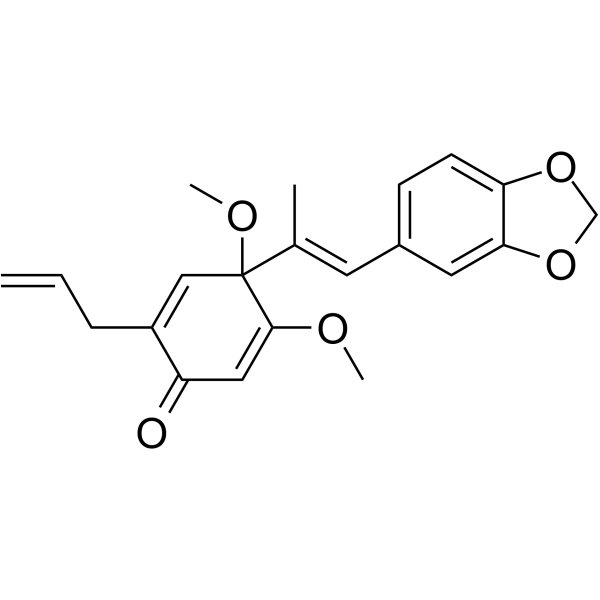
Futoquinol
CAS No. 28178-92-9
Futoquinol( —— )
Catalog No. M31476 CAS No. 28178-92-9
Futoquinol is an anti-platelet activating factor principle from the stem part of Piper futokadsura (Piperaceae), the Chinese drug haifengteng.
Purity : >98% (HPLC)
 COA
Datasheet
HNMR
HPLC
MSDS
Handing Instructions
COA
Datasheet
HNMR
HPLC
MSDS
Handing Instructions
| Size | Price / USD | Stock | Quantity |
| 5MG | 234 | In Stock |


|
| 50MG | Get Quote | In Stock |
|
| 100MG | Get Quote | In Stock |
|
| 200MG | Get Quote | In Stock |
|
| 500MG | Get Quote | In Stock |
|
| 1G | Get Quote | In Stock |
|
Biological Information
-
Product NameFutoquinol
-
NoteResearch use only, not for human use.
-
Brief DescriptionFutoquinol is an anti-platelet activating factor principle from the stem part of Piper futokadsura (Piperaceae), the Chinese drug haifengteng.
-
DescriptionFutoquinol is an anti-platelet activating factor principle from the stem part of Piper futokadsura (Piperaceae), the Chinese drug haifengteng.
-
In VitroFutoquinol potently inhibits NO production with an IC50 value of 16.8 μM in LPS-activated BV-2 cells, a microglia cell line.
-
In Vivo——
-
Synonyms——
-
PathwayOthers
-
TargetOther Targets
-
Recptor——
-
Research Area——
-
Indication——
Chemical Information
-
CAS Number28178-92-9
-
Formula Weight354.4
-
Molecular FormulaC21H22O5
-
Purity>98% (HPLC)
-
Solubility——
-
SMILES——
-
Chemical Name——
Shipping & Storage Information
-
Storage(-20℃)
-
ShippingWith Ice Pack
-
Stability≥ 2 years
Reference
molnova catalog



related products
-
(Arg8,des-Gly-NH29)-...
(Arg8,des-Gly-NH29)-Vasopressin
-
AZD5904
AZD5904 (AZD-5904) is a potent, selective irreversible, orally bioavailable myeloperoxidase (MPO) inhibitor with IC50 of 140 nM.
-
Isogambogic acid
Isogambogic acid shows cytotoxic activiity against KB and drug-resistant KB-V1 cell lines.
