


 Cart
Cart
 sales@molnova.com


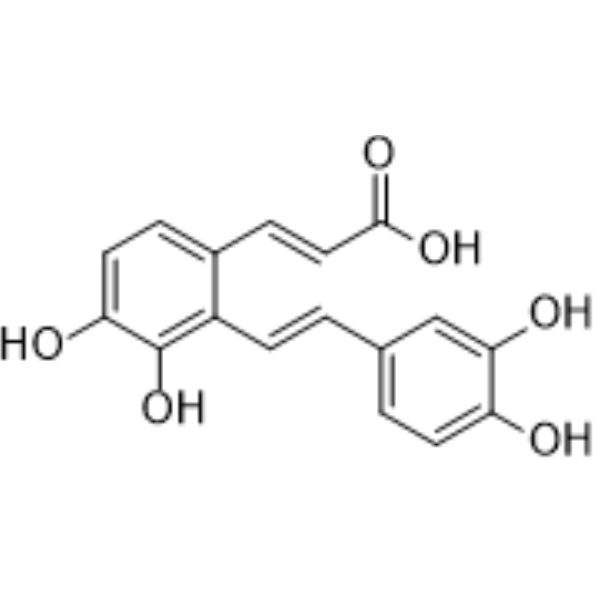
Salvianolic acid F
CAS No. 158732-59-3
Salvianolic acid F( —— )
Catalog No. M31444 CAS No. 158732-59-3
The role of our hybrid molecules, an analogue of Salvianolic acid F, in compelling the glioma cells towards apoptosis by specifically perturbing the concentration of glutathione along with caspase 6.
Purity : >98% (HPLC)
 COA
Datasheet
HNMR
HPLC
MSDS
Handing Instructions
COA
Datasheet
HNMR
HPLC
MSDS
Handing Instructions
| Size | Price / USD | Stock | Quantity |
| 5MG | 235 | In Stock |


|
| 10MG | 353 | In Stock |
|
| 25MG | 635 | In Stock |
|
| 50MG | 870 | In Stock |
|
| 100MG | 1172 | In Stock |
|
| 200MG | Get Quote | In Stock |
|
| 500MG | Get Quote | In Stock |
|
| 1G | Get Quote | In Stock |
|
Biological Information
-
Product NameSalvianolic acid F
-
NoteResearch use only, not for human use.
-
Brief DescriptionThe role of our hybrid molecules, an analogue of Salvianolic acid F, in compelling the glioma cells towards apoptosis by specifically perturbing the concentration of glutathione along with caspase 6.
-
DescriptionThe role of our hybrid molecules, an analogue of Salvianolic acid F, in compelling the glioma cells towards apoptosis by specifically perturbing the concentration of glutathione along with caspase 6.
-
In Vitro——
-
In Vivo——
-
Synonyms——
-
PathwayOthers
-
TargetOther Targets
-
Recptor——
-
Research Area——
-
Indication——
Chemical Information
-
CAS Number158732-59-3
-
Formula Weight314.3
-
Molecular FormulaC17H14O6
-
Purity>98% (HPLC)
-
SolubilityIn Vitro:?DMSO : 100 mg/mL (318.18 mM)
-
SMILES——
-
Chemical Name——
Shipping & Storage Information
-
Storage(-20℃)
-
ShippingWith Ice Pack
-
Stability≥ 2 years
Reference
molnova catalog



related products
-
RS5517
RS5517 is a novel PDZ1 structural domain ligand for the study of colorectal cancer.
-
Orexin B, human TFA ...
Orexin B, human (TFA) is an endogenous agonist at Orexin receptor with Kis of 420 and 36 nM for OX1 and OX2.
-
DCZ0415
DCZ0415 induces antimyeloma activity in vitro, in vivo and in primary cells of drug-resistant myeloma patients. DCZ0415 is a potent TRIP13 inhibitor that can impair the repair of non-homologous end junctions and inhibit NF-κB activity.DCZ0415 (10, 20 μM; 72 hours) showed a marked reduction in colony formation, indicating that it inhibited cell proliferation.
