


 Cart
Cart
 sales@molnova.com


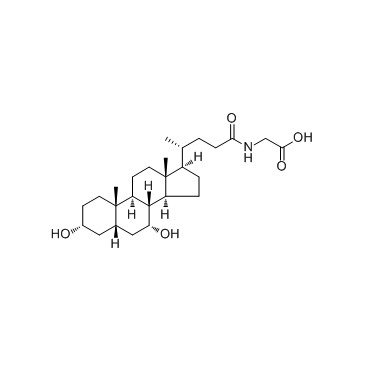
Glycochenodeoxycholic Acid
CAS No. 640-79-9
Glycochenodeoxycholic Acid( Chenodeoxycholylglycine )
Catalog No. M18944 CAS No. 640-79-9
Glycolithocholic acid is a glycine conjugate of lithocholic acid, a bile acid. It is increased in livers of mice that are fed diets supplemented with ursadeoxycholic acid.
Purity : >98% (HPLC)
 COA
Datasheet
HNMR
HPLC
MSDS
Handing Instructions
COA
Datasheet
HNMR
HPLC
MSDS
Handing Instructions
| Size | Price / USD | Stock | Quantity |
| 1 mL x 10 mM in DMSO | 49 | In Stock |


|
| 5MG | 29 | In Stock |
|
| 10MG | 45 | In Stock |
|
| 25MG | 72 | In Stock |
|
| 50MG | 104 | In Stock |
|
| 100MG | 153 | In Stock |
|
| 200MG | 228 | In Stock |
|
| 500MG | 387 | In Stock |
|
| 1G | Get Quote | In Stock |
|
Biological Information
-
Product NameGlycochenodeoxycholic Acid
-
NoteResearch use only, not for human use.
-
Brief DescriptionGlycolithocholic acid is a glycine conjugate of lithocholic acid, a bile acid. It is increased in livers of mice that are fed diets supplemented with ursadeoxycholic acid.
-
DescriptionGlycolithocholic acid is a glycine conjugate of lithocholic acid, a bile acid. It is increased in livers of mice that are fed diets supplemented with ursadeoxycholic acid. Glycolithocholic acid levels are decreased in lean mice treated with obestatin. Serum glycolithocholic acid levels increase with age in children.
-
In Vitro——
-
In Vivo——
-
SynonymsChenodeoxycholylglycine
-
PathwayOthers
-
TargetOther Targets
-
RecptorOthers
-
Research Area——
-
Indication——
Chemical Information
-
CAS Number640-79-9
-
Formula Weight449.62
-
Molecular FormulaC26H43NO5
-
Purity>98% (HPLC)
-
SolubilityDMSO : ≥ 29 mg/mL; 64.50 mM
-
SMILESO=C(O)CNC(=O)CC[C@@H](C)[C@H]4CC[C@@H]1[C@]4(C)CC[C@@H]2[C@@]3(C)CC[C@@H](O)C[C@H]3C[C@@H](O)[C@@H]12
-
Chemical Name——
Shipping & Storage Information
-
Storage(-20℃)
-
ShippingWith Ice Pack
-
Stability≥ 2 years
Reference
1.Kuipers F, Derksen JP, Gerding A, Scherphof GL, Vonk RJ. Biochim Biophys Acta. 1987 Nov 21;922(2):136-44.
molnova catalog



related products
-
cis-ε-Viniferin
cis-epsilon-Viniferin is a natural product.
-
Ilicic acid
Ilicic acid is a natural product of Laggera, Asteraceae. The catalog number is T4802 and the CAS number is 4586-68-9. Ilicic acid can be used as a reference standard.
-
1H-Cyclohepta[a]naph...
17(13→14)-Abeo-ent-3S*,13S*,16-trihydroxystrob-8(15)-ene is a natural sesquiterpene lactone with anti-inflammatory activity.
