


 Cart
Cart
 sales@molnova.com


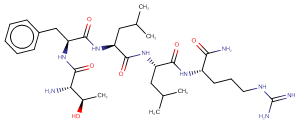
TFLLR-NH2
CAS No. 197794-83-5
TFLLR-NH2( —— )
Catalog No. M30117 CAS No. 197794-83-5
TFLLR-NH2 is a protease-activated receptor (PARs) agonist which is more selective to PAR-1 than SFLLRN-NH2.
Purity : >98% (HPLC)
 COA
Datasheet
HNMR
HPLC
MSDS
Handing Instructions
COA
Datasheet
HNMR
HPLC
MSDS
Handing Instructions
| Size | Price / USD | Stock | Quantity |
| 5MG | 464 | Get Quote |


|
| 10MG | 697 | Get Quote |
|
| 100MG | Get Quote | Get Quote |
|
| 200MG | Get Quote | Get Quote |
|
| 500MG | Get Quote | Get Quote |
|
| 1G | Get Quote | Get Quote |
|
Biological Information
-
Product NameTFLLR-NH2
-
NoteResearch use only, not for human use.
-
Brief DescriptionTFLLR-NH2 is a protease-activated receptor (PARs) agonist which is more selective to PAR-1 than SFLLRN-NH2.
-
DescriptionTFLLR-NH2 is a protease-activated receptor (PARs) agonist which is more selective to PAR-1 than SFLLRN-NH2. (In Vitro):PAR1 agonists stimulate concentration-dependent increases in [Ca2+]i and in the proportions of neurones. The maximal increase in [Ca2+]i above basal is detected in response to 10 μm TF-NH2(peak 196.5±20.4 nM, n=25) when 50–80% of identified neurones responded. SW620 cells cultured in the supernatant of TFLLR-NH2-activated platelets upregulate E-cadherin expression and downregulate the vimentin expression. In the in vitro platelet culture system, a TFLLR-NH2 dose-dependent increase of secreted TGF-β1 is detected in the supernatant.(In Vivo):Injection of TF-NH2 into the rat paw stimulates a marked and sustained oedema. An NK1R antagonist and ablation of sensory nerves with capsaicin inhibit oedema by 44% at 1 h and completely by 5 h. In wild-type but not PAR1 / mice, TF-NH2 stimulates Evans blue extravasation in the bladder, oesophagus, stomach, intestine and pancreas by 2–8 fold. Extravasation in the bladder, oesophagus and stomach is abolished by an NK1R antagonist. TFp-NH2 produces notable contraction at 3-50 μM and relaxation at 0.3-50 μM, in the absence of apamin. The concentration-response curve for TFp-NH2-induced contraction is remarkably shifted left, when the TFp-NH2-induced relaxation is blocked by apamin at 0.1 μM.
-
In VitroPAR1 agonists stimulate concentration-dependent increases in [Ca2+]i and in the proportions of neurones. The maximal increase in [Ca2+]i above basal is detected in response to 10?μm TF-NH2(peak 196.5±20.4?nM, n=25) when 50–80% of identified neurones responded. SW620 cells cultured in the supernatant of TFLLR-NH2-activated platelets upregulate E-cadherin expression and downregulate the vimentin expression. In the in vitro platelet culture system, a TFLLR-NH2 dose-dependent increase of secreted TGF-β1 is detected in the supernatant.
-
In VivoInjection of TF-NH2 into the rat paw stimulates a marked and sustained oedema. An NK1R antagonist and ablation of sensory nerves with capsaicin inhibit oedema by 44% at 1?h and completely by 5?h. In wild-type but not PAR1?/? mice, TF-NH2 stimulates Evans blue extravasation in the bladder, oesophagus, stomach, intestine and pancreas by 2–8 fold. Extravasation in the bladder, oesophagus and stomach is abolished by an NK1R antagonist. TFp-NH2 produces notable contraction at 3-50 μM and relaxation at 0.3-50 μM, in the absence of apamin. The concentration-response curve for TFp-NH2-induced contraction is remarkably shifted left, when the TFp-NH2-induced relaxation is blocked by apamin at 0.1 μM.
-
Synonyms——
-
PathwayGPCR/G Protein
-
TargetPAR
-
RecptorEC50: 1.9 μM (PAR1)
-
Research Area——
-
Indication——
Chemical Information
-
CAS Number197794-83-5
-
Formula Weight647.81
-
Molecular FormulaC31H53N9O6
-
Purity>98% (HPLC)
-
Solubility——
-
SMILES——
-
Chemical NameSequence:Thr-Phe-Leu-Leu-Arg-NH2
Shipping & Storage Information
-
Storage(-20℃)
-
ShippingWith Ice Pack
-
Stability≥ 2 years
Reference
de Garavilla L, et al. Agonists of proteinase-activated receptor 1 induce plasma extravasation by a neurogenic mechanism. Br J Pharmacol. 2001 Aug;133(7):975-87.
molnova catalog



related products
-
BMS-986120
BMS-986120 (BMS986120)?is a potent, selective, orally bioavailable, and reversible PAR4 antagonist with Kd of 0.098 nM for human PAR4.
-
BMS-986141
BMS-986141(UDM-003183) is a selective and potent protease-activated receptor-4 (PAR-4) antagonist with oral activity and an IC50 value of 0.4 nM.BMS-98614 exhibits significant antithrombotic effects.
-
SSR128129E
SSR128129E is an allosteric and orally-active FGFR1 inhibitor (IC50: 1.9 μM), but not affecting other related RTKs.
