


 Cart
Cart
 sales@molnova.com


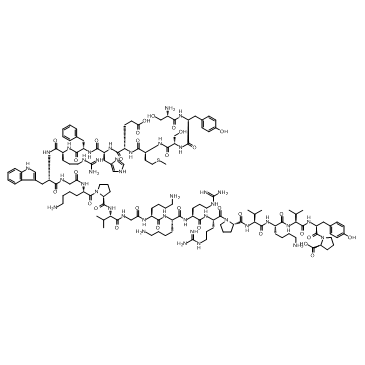
Tetracosactide
CAS No. 16960-16-0
Tetracosactide( —— )
Catalog No. M29730 CAS No. 16960-16-0
Tetracosactide (INN) is a synthetic peptide that is identical to the 24-amino acid segment (sequence: SYSMEHFRWGKPVGKKRRPVKVYP) at the N-terminal of adrenocorticotropic hormone.
Purity : >98% (HPLC)
 COA
Datasheet
HNMR
HPLC
MSDS
Handing Instructions
COA
Datasheet
HNMR
HPLC
MSDS
Handing Instructions
| Size | Price / USD | Stock | Quantity |
| 5MG | 113 | In Stock |


|
| 10MG | 183 | In Stock |
|
| 25MG | 312 | In Stock |
|
| 50MG | 440 | In Stock |
|
| 100MG | 616 | In Stock |
|
| 200MG | 830 | In Stock |
|
| 500MG | Get Quote | In Stock |
|
| 1G | Get Quote | In Stock |
|
Biological Information
-
Product NameTetracosactide
-
NoteResearch use only, not for human use.
-
Brief DescriptionTetracosactide (INN) is a synthetic peptide that is identical to the 24-amino acid segment (sequence: SYSMEHFRWGKPVGKKRRPVKVYP) at the N-terminal of adrenocorticotropic hormone.
-
DescriptionTetracosactide (INN) is a synthetic peptide that is identical to the 24-amino acid segment (sequence: SYSMEHFRWGKPVGKKRRPVKVYP) at the N-terminal of adrenocorticotropic hormone.
-
In Vitro——
-
In Vivo——
-
Synonyms——
-
PathwayOthers
-
TargetOther Targets
-
Recptor——
-
Research Area——
-
Indication——
Chemical Information
-
CAS Number16960-16-0
-
Formula Weight2933.44
-
Molecular FormulaC136H210N40O31S
-
Purity>98% (HPLC)
-
SolubilityIn Vitro:?H2O : 100 mg/mL (34.09 mM)
-
SMILES——
-
Chemical Name——
Shipping & Storage Information
-
Storage(-20℃)
-
ShippingWith Ice Pack
-
Stability≥ 2 years
Reference
molnova catalog



related products
-
3-Methylbutanoic aci...
3-Methylbutanoic acid is a naturally occurring aroma compound found in Bartlett pear brandies vanilla beans rape-honey and banana.
-
α-Terpineol
α-Terpineol has antitumour anti-inflammatory and antimicrobial activities it inhibits the growth of tumour cells through a mechanism that involves inhibition of the NF-kappaB pathway.
-
Ganoderenic acid C
Ganoderenic acid C is a natural product.
