


 Cart
Cart
 sales@molnova.com


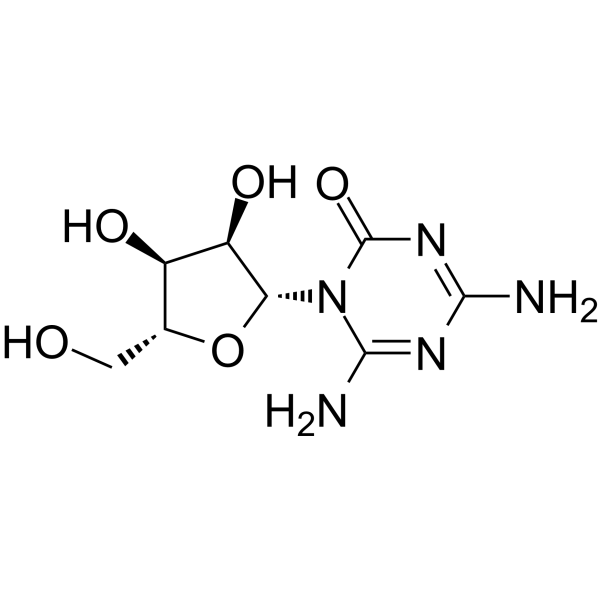
6-Amino-5-azacytidine
CAS No. 105331-00-8
6-Amino-5-azacytidine( —— )
Catalog No. M29594 CAS No. 105331-00-8
6-Amino-5-azacytidine has an inhibitory of the growth of E. coli.
Purity : >98% (HPLC)
 COA
Datasheet
HNMR
HPLC
MSDS
Handing Instructions
COA
Datasheet
HNMR
HPLC
MSDS
Handing Instructions
| Size | Price / USD | Stock | Quantity |
| 5MG | 70 | In Stock |


|
| 10MG | 126 | In Stock |
|
| 25MG | 214 | In Stock |
|
| 50MG | 308 | In Stock |
|
| 100MG | 439 | In Stock |
|
| 200MG | 613 | In Stock |
|
| 500MG | Get Quote | In Stock |
|
| 1G | Get Quote | In Stock |
|
Biological Information
-
Product Name6-Amino-5-azacytidine
-
NoteResearch use only, not for human use.
-
Brief Description6-Amino-5-azacytidine has an inhibitory of the growth of E. coli.
-
Description6-Amino-5-azacytidine has an inhibitory of the growth of E. coli.(In Vitro):6-Amino-5-azacytidine has an ID50 of 33.9 μM against CCRF-CEM cells and inhibits the growth of WI-L2 cells by 39% at 100 μM.
-
In Vitro6-Amino-5-azacytidine has an ID50 of 33.9 μM against CCRF-CEM cells and inhibits the growth of WI-L2 cells by 39% at 100 μM.
-
In Vivo——
-
Synonyms——
-
PathwayGPCR/G Protein
-
TargetAntibacterial
-
RecptorAntibacterial
-
Research Area——
-
Indication——
Chemical Information
-
CAS Number105331-00-8
-
Formula Weight259.222
-
Molecular FormulaC8H13N5O5
-
Purity>98% (HPLC)
-
SolubilityIn Vitro:?H2O : 14.71 mg/mL (56.75 mM)
-
SMILESNc1nc(N)n(C2O[C@H](CO)C(O)C2O)c(=O)n1
-
Chemical Name——
Shipping & Storage Information
-
Storage(-20℃)
-
ShippingWith Ice Pack
-
Stability≥ 2 years
Reference
molnova catalog



related products
-
Delpazolid
A novel oxazolidinone antibiotic that shows good antibacterial activity (MSSA MIC50=1 ug/mL).
-
Ombuoside
Ombuoside has antifungal activity. Ombuoside shows significant antioxidant activity in the DPPH, and TEAC, reducing power assays.Ombuoside is a glycoside ombuoside isolated from Gynostemma pentaphyllum.
-
Kanosamine
Kanosamine is an antifungal agent produced by a Streptomyces sp.
