


 Cart
Cart
 sales@molnova.com


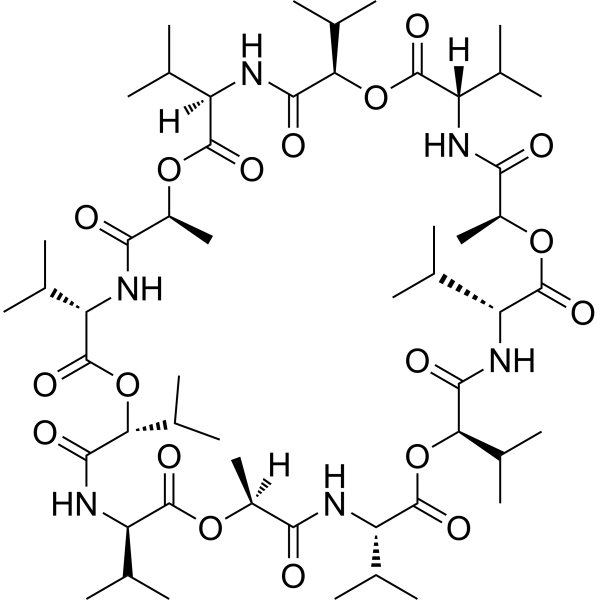
Valinomycin
CAS No. 2001-95-8
Valinomycin( NSC 122023 )
Catalog No. M29573 CAS No. 2001-95-8
Valinomycin is a cyclic depsipeptide antibiotic and a potassium-specific ionophore.Valinomycin induces PINK1 activation and promotes Parkin phosphorylation at Ser65.
Purity : >98% (HPLC)
 COA
Datasheet
HNMR
HPLC
MSDS
Handing Instructions
COA
Datasheet
HNMR
HPLC
MSDS
Handing Instructions
| Size | Price / USD | Stock | Quantity |
| 1 mL x 10 mM in DMSO | 71 | In Stock |


|
| 5MG | 38 | In Stock |
|
| 10MG | 53 | In Stock |
|
| 25MG | 101 | In Stock |
|
| 50MG | 145 | In Stock |
|
| 100MG | Get Quote | In Stock |
|
| 200MG | Get Quote | In Stock |
|
| 500MG | Get Quote | In Stock |
|
| 1G | Get Quote | In Stock |
|
Biological Information
-
Product NameValinomycin
-
NoteResearch use only, not for human use.
-
Brief DescriptionValinomycin is a cyclic depsipeptide antibiotic and a potassium-specific ionophore.Valinomycin induces PINK1 activation and promotes Parkin phosphorylation at Ser65.
-
DescriptionValinomycin is a cyclic depsipeptide antibiotic and a potassium-specific ionophore.Valinomycin induces PINK1 activation and promotes Parkin phosphorylation at Ser65.(In Vitro):Valinomycin significantly induced CHO cell death within 12 hours after administration. In CHO cells treated with valinomycin, within the first few hours, multiple apoptotic features were observed, including caspase-3 activation, phosphatidylserine (PS) membrane translocation, and mitochondrial membrane depolarization. Increasing the extracellular potassium concentration can reduce potassium efflux .(In Vivo):Valinomycin is irritating in contact with eyes and skin. Inhalation of Valinomycin can cause respiratory disturbances and even loss of consciousness. The median lethal dose (LD50) of Valinomycin in mice and rabbits was 2.5 mg/kg and 5 mg/kg, respectively. Valinomycin also has various chronic effects, including central and peripheral nervous system damage, eye damage, lens damage, and corneal damage .
-
In Vitro——
-
In VivoAnimal Model:nude mice with HepG2 Dosage:1, 2, 5, 10, 20, 40 μg/g Administration:Intravenous injection (i.v.), every two days for 16 d Result:Exerted remarkable inhibition effect on tumor growth and no weight loss during the therapeutic period. Caused destructive tumor necrosis as most of the tumor cells were in apoptotic status.
-
SynonymsNSC 122023
-
PathwayApoptosis
-
TargetApoptosis
-
RecptorApoptosis
-
Research Area——
-
Indication——
Chemical Information
-
CAS Number2001-95-8
-
Formula Weight1111.32
-
Molecular FormulaC54H90N6O18
-
Purity>98% (HPLC)
-
SolubilityIn Vitro:?Ethanol : 50 mg/mL (44.99 mM)
-
SMILESCC(C)[C@H](C(O[C@@H](C)C(N[C@@H](C(C)C)C(O[C@H](C(C)C)C(N[C@H](C(C)C)C(O[C@@H](C)C(N[C@@H](C(C)C)C(O[C@H](C(C)C)C(N[C@H](C(C)C)C(O[C@@H](C)C(N[C@@H](C(C)C)C(O[C@@H]1C(C)C)=O)=O)=O)=O)=O)=O)=O)=O)=O)=O)=O)NC1=O
-
Chemical Name——
Shipping & Storage Information
-
Storage(-20℃)
-
ShippingWith Ice Pack
-
Stability≥ 2 years
Reference
molnova catalog



related products
-
Pamrevlumab
Pamrevlumab (FG-3019) is a human antibody with affinity for connective tissue growth factor (CTGF) and is involved in anti-CTGF therapy for the treatment of idiopathic pulmonary fibrosis (IPF).
-
Silvestrol aglycone
Silvestrol is a potential anticancer rocaglate derivative from Aglaia foveolata, induces apoptosis in cancer cells through the mitochondrial/apoptosome pathway.
-
N-Hexanoyl-D-sphingo...
C6-ceramide, a ceramide pathway activator, shows activity against a variety of cancer cell lines. C6-ceramide can be used as an adjuvant for chemotherapeutic agents, to enhance anti-tumor effects.
