


 Cart
Cart
 sales@molnova.com


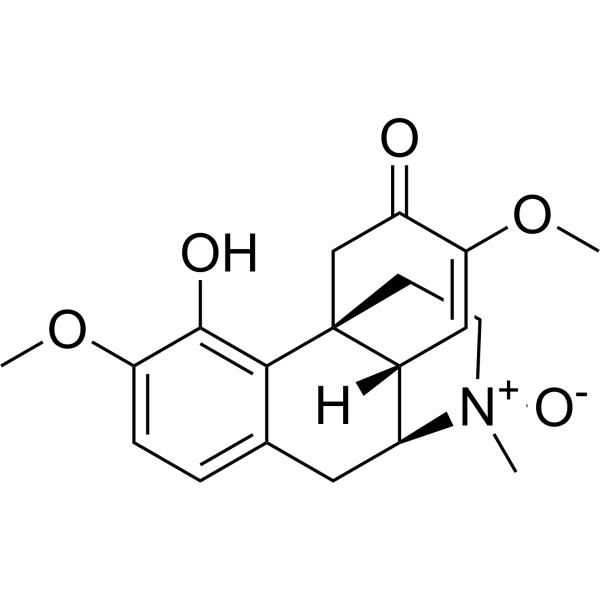
Sinomenine N-oxide
CAS No. 1000026-77-6
Sinomenine N-oxide( —— )
Catalog No. M29455 CAS No. 1000026-77-6
Sinomenine N-oxide is one of the major metabolites of the cyclic metabolic mechanism of Sinomenine.
Purity : >98% (HPLC)
 COA
Datasheet
HNMR
HPLC
MSDS
Handing Instructions
COA
Datasheet
HNMR
HPLC
MSDS
Handing Instructions
| Size | Price / USD | Stock | Quantity |
| 1 mL x 10 mM in DMSO | 377 | In Stock |


|
| 5MG | 188 | In Stock |
|
| 10MG | 277 | In Stock |
|
| 100MG | Get Quote | In Stock |
|
| 200MG | Get Quote | In Stock |
|
| 500MG | Get Quote | In Stock |
|
| 1G | Get Quote | In Stock |
|
Biological Information
-
Product NameSinomenine N-oxide
-
NoteResearch use only, not for human use.
-
Brief DescriptionSinomenine N-oxide is one of the major metabolites of the cyclic metabolic mechanism of Sinomenine.
-
DescriptionSinomenine N-oxide is one of the major metabolites of the cyclic metabolic mechanism of Sinomenine.
-
In Vitro——
-
In Vivo——
-
Synonyms——
-
PathwayOthers
-
TargetOther Targets
-
Recptor——
-
Research Area——
-
Indication——
Chemical Information
-
CAS Number1000026-77-6
-
Formula Weight345.39
-
Molecular FormulaC19H23NO5
-
Purity>98% (HPLC)
-
Solubility——
-
SMILES[H][C@]1([C@@]2(C3)C4=C(O)C(OC)=CC=C4C[C@]1([H])[N+](C)([O-])CC2)C=C(OC)C3=O
-
Chemical Name——
Shipping & Storage Information
-
Storage(-20℃)
-
ShippingWith Ice Pack
-
Stability≥ 2 years
Reference
molnova catalog



related products
-
MARCKS PSD-Derived P...
MARCKS PSD-Derived Peptide, PKC Substrate
-
H-Asp-Arg-Asn-Phe-Le...
H-Asp-Arg-Asn-Phe-Leu-Arg-Phe-NH2
-
Acetyl-(Nle4,Asp5,D-...
SHU 9119 is a potent human melanocortin 3 and 4 receptors (MC3/4R) antagonist and a partial MC5R agonist; with IC50 values of 0.23, 0.06, and 0.09 nM for human MC3R, MC4R and MC5R, respectively.
