


 Cart
Cart
 sales@molnova.com


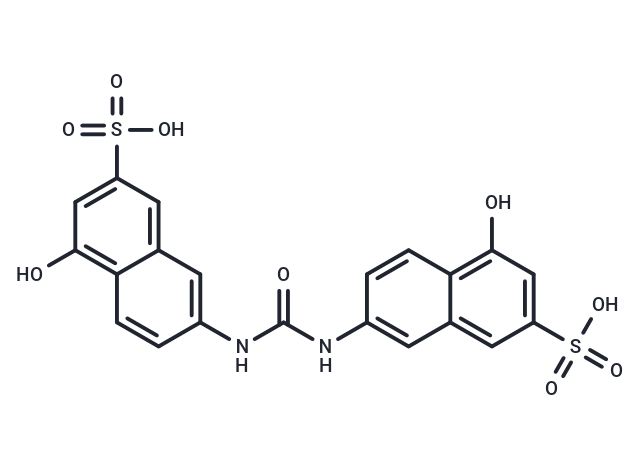
AMI-1 free acid
CAS No. 134-47-4
AMI-1 free acid( —— )
Catalog No. M33795 CAS No. 134-47-4
AMI-1 free acid is a potent, cell-permeable, and reversible inhibitor of protein arginine N-methyltransferases (PRMTs), with inhibitory concentration 50 (IC50) values of 8.8 μM for human PRMT1 and 3.0 μM for yeast-Hmt1p.
Purity : >98% (HPLC)
 COA
Datasheet
HNMR
HPLC
MSDS
Handing Instructions
COA
Datasheet
HNMR
HPLC
MSDS
Handing Instructions
| Size | Price / USD | Stock | Quantity |
| 1 mL x 10 mM in DMSO | 28 | In Stock |


|
| 25MG | 38 | In Stock |
|
| 50MG | 52 | In Stock |
|
| 100MG | 75 | In Stock |
|
| 200MG | Get Quote | In Stock |
|
| 500MG | 184 | In Stock |
|
| 1G | 272 | In Stock |
|
Biological Information
-
Product NameAMI-1 free acid
-
NoteResearch use only, not for human use.
-
Brief DescriptionAMI-1 free acid is a potent, cell-permeable, and reversible inhibitor of protein arginine N-methyltransferases (PRMTs), with inhibitory concentration 50 (IC50) values of 8.8 μM for human PRMT1 and 3.0 μM for yeast-Hmt1p.
-
DescriptionAMI-1 free acid is a potent, cell-permeable and reversible inhibitor of protein arginine N-methyltransferases (PRMTs), with IC50s of 8.8 μM and 3.0 μM for human PRMT1 and yeast-Hmt1p, respectively. AMI-1 free acid exerts PRMTs inhibitory effects by blocking peptide-substrate binding.
-
In VitroAMI-1 free acid can inhibit the in vitro methylation reactions performed by all five recombinantly active PRMTs (PRMT1, -3, -4, and -6 and Hmt1p).AMI-1 free acid not only inhibits type I PRMTs (PRMT1, 3, 4 and 6) but also type II PRMT5. AMI-1 free acid specifically inhibits arginine, but not lysine, methyltransferase activity in vitro and does not compete for the AdoMet binding site. AMI-1 free acid inhibits methylation of GFP-Npl3 and cellular proteins.AMI-1 free acid (0.6-2.4 mM; 48-96 hours) inhibits the cell viability of sarcoma in S180 and U2OS cells in a time-dependent and dose-dependent manner in vitro.AMI-1 free acid (1.2-2.4 mM; 48-72 hours) reduces S180 cell viability through the induction of cell apoptosis.Cell Viability Assay Cell Line:S180 cells, U2OS cells Concentration:0.6 mM, 1.2 mM, 2.4 mM Incubation Time:48 hours, 72 hours, 96 hours Result:Inhibited the cell viability.Apoptosis Analysis Cell Line:S180 cellsConcentration:1.2 mM, 2.4 mM Incubation Time:48 hours, 72 hours Result:Increased the percentages of cells undergoing apoptosis.
-
In VivoAMI-1 free acid (0.5 mg; intratumorally; daily; for 7 days) inhibits S180 viability in vivo.AMI-1 free acid (0.5 mg; intratumorally; daily; for 7 days) downregulates PRMT5 but does not regulate the expression of PRMT7 in a tumor xenograft model.AMI-1 free acid (0.5 mg; intratumorally; daily; for 7 days) decreases the levels of H4R3me2s and H3R8me2s in a tumor xenograft model.Animal Model:6-7 weeks old male Kunming mice (18-22 g), with S180 cells xenograft Dosage:0.5 mg Administration: Intratumorally, daily, for 7 days Result:Decreased tumor weight.
-
Synonyms——
-
PathwayOthers
-
TargetOther Targets
-
RecptorHistone Methyltransferase
-
Research Area——
-
Indication——
Chemical Information
-
CAS Number134-47-4
-
Formula Weight504.49
-
Molecular FormulaC21H16N2O9S2
-
Purity>98% (HPLC)
-
SolubilityIn Vitro:?DMSO : 83.33 mg/mL (165.18 mM; Ultrasonic )
-
SMILESO=C(NC=1C=CC2=C(O)C=C(C=C2C1)S(=O)(=O)O)NC=3C=CC4=C(O)C=C(C=C4C3)S(=O)(=O)O
-
Chemical Name——
Shipping & Storage Information
-
Storage(-20℃)
-
ShippingWith Ice Pack
-
Stability≥ 2 years
Reference
1. Zhang, B., et al. Targeting protein arginine methyltransferase 5 inhibits colorectal cancer growth by decreasing arginine methylation of eIF4E and FGFR3. Oncotarget. 2015 Sep 8;6(26):22799-811.?
molnova catalog



related products
-
NTNCB hydrochloride
NTNCB hydrochloride is an antagonist of neuropeptide Y (NPY) Y5 receptor.
-
(S,R,S)-AHPC-Me-C10-...
(S,R,S)-AHPC-Me-C10-NH2 hydrochloride is a synthesized E3 ligase ligand-linker conjugate incorporating a VHL ligand and a linker.
-
Fradiomycin
Fradiomycin or neomycin, an aminoglycoside antibiotic, is first isolated in 1949 from the gram-positive bacillus Streptomyces fradiae.
